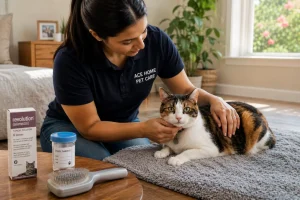
Pets cannot tell you directly that their current care arrangement is not meeting their needs. What they do instead is show you — in behavioral changes that accumulate gradually, physical shifts that develop over weeks, and patterns that are easy to rationalize when you see them every day and hard to ignore once they are pointed out.
Most owners whose pets are under-cared-for are not neglecting them intentionally. They are working long hours, managing full schedules, and telling themselves their pet seems fine when they are home. The problem is that how a pet presents in the evenings and on weekends is not a reliable indicator of how they are doing during the hours when their owner is absent. This blog is a guide to the signs that the current arrangement is falling short — and what each sign is actually communicating.
Why Owners Often Miss the Signs
The signs that a pet needs more care are almost always present before the owner recognizes them. There are several reasons for this.
The first is gradual onset. Most of these behavioral changes develop incrementally over weeks or months rather than appearing suddenly. A dog who is mildly over-excited at homecoming becomes a dog who is frantic. A cat who grooms slightly more than usual becomes one with thinning patches on their belly. The baseline shifts slowly, and owners recalibrate their sense of normal without noticing.
The second is motivated reasoning. Acknowledging that a pet needs more care than they are currently receiving means acknowledging that the current arrangement needs to change — and change requires effort, expense, or both. It is genuinely easier to interpret a dog’s frantic homecoming as enthusiasm and affection than to recognize it as evidence of a day spent in sustained waiting. Both interpretations are available. Owners tend toward the one that does not require action.
| The most useful question to ask when evaluating your pet’s current care level is not ‘Do they seem okay when I get home?’ but ‘What is their day actually like between the time I leave and the time I return?’ Those hours are the ones the signs below are measuring. |
Signs Your Dog Needs More Care — What Each One Means
The behaviors below are not personality quirks or breed traits. They are communications — a dog’s way of expressing that a physical or psychological need is not being met on a consistent enough basis.
| Sign | What It Reveals | When to Act |
| Hyperactive homecoming — frantic, jumping, unable to settle for 15+ minutes | Pent-up energy from insufficient activity — the greeting reflects the length of the wait | If consistent, not just occasional |
| Destructive behavior — chewing, scratching, digging indoors | Boredom and under-stimulation; dog is creating their own activity | After ruling out medical causes |
| Neighbor complaints about barking or howling all day | Separation distress or boredom — the dog is signaling throughout the day, not just at departure | Immediately — ongoing issue |
| House-training regression in adult dogs | Holding too long with no outdoor access; physical need exceeding current care schedule | More than one or two incidents |
| Sleeping all day when owner is home, no interest in play | Physical depletion from insufficient rest cycle — or shutdown from chronic under-stimulation | If pattern persists beyond a week |
| Obsessive or repetitive behaviors: pacing, spinning, excessive licking | Stress response — anxiety expressed through self-soothing or displacement behavior | If more than occasional |
| Gradual weight gain with no diet change | Reduced activity level below what the dog requires for healthy weight maintenance | Visible over 4–6 weeks |
| Escalating attention demand — following owner constantly, pawing for contact | Attachment anxiety building; undersocialization during alone periods | When it becomes exhausting or anxious |
The Homecoming Test — Reading What Your Dog’s Greeting Tells You
How your dog greets you when you walk in the door after a full workday is one of the most information-rich moments in your relationship with them, and one that owners almost universally misread.
What a healthy homecoming looks like
A dog whose daily needs are being met comes to the door — tail wagging, happy to see you — and settles within a few minutes. They check in, they are genuinely pleased, and then they move into the evening’s routine without escalating. This is the greeting of an animal whose day had structure and activity and who has energy to spare for a relaxed evening.
What an under-cared-for homecoming looks like
A dog who has been waiting for ten or eleven hours for this moment does not have a measured greeting. They have an explosion. Jumping, mouthing, inability to hold still, circling, barking, running back and forth — this is not enthusiasm. This is the release of a day’s worth of accumulated need in one compressed burst. The length of time it takes the dog to settle after you arrive tells you something direct about what the day before your arrival looked like.
A dog that cannot settle for fifteen minutes or more after a normal workday arrival is showing you a care gap, not a personality trait. The intensity of the greeting is proportional to the length and inadequacy of the wait that preceded it.
How Jacksonville’s Summer Compounds the Problem
In most parts of the country, an owner who cannot provide a midday walk still has the option of a dog door or a yard where the dog can self-exercise during the day. In Jacksonville from roughly May through September, that option is largely unavailable for most of the day — the heat and humidity that make outdoor activity dangerous for pets also eliminate the self-exercise option that substitutes for a structured walk in cooler climates.
A Jacksonville dog in a standard suburban home during July is managing ten to eleven hours of indoor confinement with no meaningful outdoor access for the majority of that period. The summer behavioral signs described above — destructive behavior, house-training regression, hyperactive homecoming — develop faster and more severely in this environment than they would in a home where the dog had yard access throughout the day.
This is one of the most direct arguments for professional midday care during Jacksonville’s summer months. A dog that is exercised at 7 a.m. and again at noon, then walks again at 6 p.m., is living a structurally different day from one who goes from 7 a.m. to 6 p.m. with no outdoor access. The behavioral difference by autumn is significant enough that owners who start midday care in summer routinely report that their dog at the end of the summer is noticeably calmer and more manageable than the dog who started it.
Signs Your Cat Needs More Daily Care
Cats are often assumed to be self-sufficient in ways that lead their owners to provide less than they actually need. An indoor cat who spends ten to twelve hours alone daily is not content by default — they are managing a deficit of stimulation and interaction that expresses itself in ways that are easy to attribute to other causes.
Over-grooming and coat changes
Cats that groom excessively as a stress response develop thinning or bare patches — typically on the belly, inner thighs, and base of the tail. The grooming behavior often happens during the owner’s absence and the hair loss is the first visible indicator. A cat whose coat has changed noticeably over several months without any dietary or health explanation may be self-soothing through excessive grooming driven by under-stimulation or anxiety.
Redirected aggression and increased irritability
A cat that is chronically under-stimulated accumulates a frustration response that expresses itself in unpredictable aggression — swatting without warning, biting during what appeared to be affectionate contact, aggressive behavior toward other pets in the household. This is not a character flaw. It is an animal whose internal arousal level has been elevated by boredom and whose tolerance threshold for stimulation has dropped accordingly. Increasing structured daily activity and interaction typically reduces redirected aggression significantly within a few weeks.
Increased nighttime vocalization
A cat that begins calling loudly at night — particularly one who was previously quiet — is often one who has been insufficiently stimulated during the day and is trying to initiate interaction during the hours when their owner is available. Cats that sleep most of the day from boredom and inactivity have normal feline energy cycles that then peak at night. Increasing daytime enrichment, play, and interaction often resolves nighttime vocalization more effectively than any other intervention.
| Physical signs always warrant a veterinary check before attributing them to care deficiency. Weight changes, coat changes, and elimination pattern changes can have medical causes that a behavior intervention will not address. Rule out health issues first, then evaluate whether the care arrangement is meeting the animal’s needs. |
The Neighbor Test — Information You May Not Have
One source of information about your pet’s daytime behavior that most owners do not access is their neighbors. A dog that barks or howls persistently during the day is producing complaints-level noise that neighbors are often reluctant to raise directly. If you have any reason to think your dog might be vocalizing during the day — they show distress at departure, they have been noted as barky in the past — ask a trusted neighbor directly.
The neighbor test is uncomfortable to initiate precisely because it might produce an answer that requires action. But a neighbor who tells you your dog barks for two hours after you leave every morning is giving you information that changes your understanding of what your current arrangement is actually like for your pet. That information is worth having even when it is inconvenient.
What to Do With What You Find
If several of the signs above are present, the appropriate response is not guilt — it is adjustment. The current arrangement is producing outcomes that the animal is communicating discomfort with, and changing the arrangement changes the outcomes. In most cases the adjustment required is modest: a midday visit, a daily walk on a consistent schedule, a daycare session on the longest workdays.
The goal is not a perfect pet care arrangement — it is one that addresses the specific need the signs are pointing to. A dog whose main issue is the length of the midday gap needs that gap broken. A cat whose main issue is stimulation needs structured daily play. Matching the intervention to the signal is what produces results without overengineering the solution.