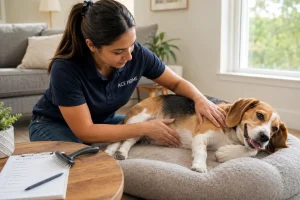
Leaving an anxious dog behind when you travel is one of the more stressful things a dog owner does — not just for the dog but for the owner who spends the trip wondering whether their arrangement is actually working. Most of the difficulty is preventable, and most of it comes from preparation that happens too late: a sitter booked in the week before the trip, a dog who has never been left with anyone other than their owner dropped into an extended absence, a travel-related anxiety that was managed through avoidance rather than addressed directly.
This guide covers how anxiety-related absence distress works in dogs, how to distinguish true separation anxiety from boredom or under-stimulation, and what the preparation process should look like to give an anxious dog the best chance of managing your absence without significant distress.
Separation Anxiety vs Owner-Absent Boredom — The Distinction Matters
The term separation anxiety is used colloquially to describe any dog that appears stressed when left alone, but the clinical term refers to a specific anxiety disorder tied to the absence of an attachment figure. True separation anxiety and owner-absent boredom look different on camera, produce different behaviors, respond differently to interventions, and require different management approaches. Getting this distinction right determines whether the solutions you put in place will actually work.
| Factor | True Separation Anxiety | Boredom / Under-Stimulation |
| When distress starts | Within minutes of departure — sometimes at departure cues (keys, bag) before owner even leaves | Later in the absence — after enrichment is exhausted, often 1–2 hours in |
| Behavior on camera | Pacing, panting, vocalization, attempts to escape at exits — sustained throughout absence | Restless for a period then settles; may sleep for long stretches |
| Destructive location | Exit points — doors, windows, crates; door frames; anywhere the owner left through | Random — furniture, cushions, objects left accessible; not exit-focused |
| Response to a second person | Partial but not complete relief — presence of anyone helps somewhat | Little change — the issue is stimulation, not attachment |
| Behavior when owner returns | Extreme, prolonged excitement that takes 15+ minutes to settle | Happy greeting that settles relatively quickly |
| Response to enrichment alone | Enrichment ignored or abandoned early — distress overrides engagement | Enrichment is used and extends the calm period meaningfully |
| Owner’s departure ritual | Watching departure cues builds anticipatory anxiety before departure begins | Departure itself may not be noticed or may produce mild response only |
The practical significance of this table is that boredom responds well to increased enrichment, structured activity, and professional care that fills the absence with engagement. True separation anxiety requires a more systematic approach — graduated absence training, and in moderate to severe cases, a veterinary behavior consultation that may include medication. Treating boredom with anxiety medication is unnecessary. Treating true separation anxiety with only enrichment and hoping for the best produces continued distress.
| Camera footage from a pet camera during an absence is the single most reliable way to distinguish true separation anxiety from boredom. A dog that is pacing and vocalizing for the full duration of a two-hour absence has a fundamentally different experience from one that searches for twenty minutes and then settles into sleep. The footage tells you what you need to know to choose the right intervention. |
The Departure Ritual Problem — How Owners Teach Anxiety
One of the least intuitive aspects of separation anxiety management is that how an owner leaves has a significant effect on how the dog experiences the absence. Most owners who have anxious dogs have developed elaborate departure rituals — long goodbyes, specific phrases, treats at the door, a particular sequence of actions before leaving. These rituals communicate to the dog that departure is a significant emotional event, which is precisely the framing that anxious dogs do not need.
What a departure ritual teaches
Dogs are pattern learners. A dog who watches their owner pick up keys, put on shoes, gather a bag, and offer a goodbye treat learns to associate that sequence with the coming absence — and begins their anxiety response before the door has even closed. By the time the owner leaves, the dog is already in an activated, distressed state. The departure ritual has not comforted them; it has extended the period of anticipatory distress.
What a low-key departure looks like
The alternative is a departure that is as unremarkable as possible. Leave without extended eye contact, without a long goodbye, without a special sequence that signals your exit. Place something engaging — a stuffed Kong, a lick mat, a puzzle feeder — a few minutes before you leave so the dog is already occupied when the exit happens. The goal is for departure to be routine rather than emotionally significant. This does not mean you cannot acknowledge your dog at all — it means that the emotional weight of the departure is yours to manage, and loading that weight onto the dog does not help them.
Building Departure Tolerance Before Your Trip — Graduated Absence Training
A dog that has never been left alone for more than a few hours and is suddenly left for five days while their owner travels has been set up to fail by a preparation process that did not exist. The most effective intervention for travel-related anxiety is graduated absence training completed before the trip — not begun the week before departure.
The graduated exposure sequence
Start with departures of five minutes — leave, return, be completely casual about both. Build to fifteen minutes, then thirty, then an hour, then two hours. Each step is repeated enough times that the dog’s response at that duration is settled before moving to the next. A dog that is calm and settled for two-hour absences is in a fundamentally different position for a five-day trip than one for whom the longest prior absence was ninety minutes and produced distress that lasted most of it.
For dogs with significant anxiety, this process takes weeks rather than days. If you travel regularly enough that this matters, the time to begin graduated exposure is not two weeks before your next trip — it is between trips, when the pressure is off and the training can happen at the right pace.
Including the sitter in the exposure sequence
If you are using a professional pet sitter, including them in the graduated exposure process significantly improves the outcome. A sitter who has visited the dog three or four times before the trip — and with whom the dog has had two or three positive experiences of being left alone briefly — is a familiar presence rather than a stranger. The sitter’s arrival during the trip does not trigger a new anxiety response on top of the owner’s absence. This is the principle behind why rushed introduction processes produce worse outcomes for anxious dogs than staged ones.
Tools That Help — and Ones That Do Not
What reliably helps
An owner-worn garment placed in the dog’s sleeping area provides a consistent olfactory presence that is genuinely calming for many dogs — not as a replacement for good preparation but as a supplement to it. Synthetic dog-appeasing pheromone products, available as diffusers, collars, and sprays, have a reasonable evidence base for mild anxiety reduction in dogs. White noise or ambient sound in the background reduces the sensory contrast between a normally occupied home and an empty one. Consistent carer visits on a predictable schedule — rather than variable timing — reduce the dog’s uncertainty about when the next human contact will arrive.
What does not help
Sedation that leaves the dog unable to engage with their environment is not anxiety management — it is incapacitation, and it leaves the underlying anxiety unaddressed while creating a dog that is disoriented and unable to process what is happening around them. Flooding — placing a highly anxious dog with a sitter for an extended first absence and hoping they adjust — produces the opposite of the intended outcome in most cases. And repeated short returns to check on the dog during early absences, done with the intention of reassuring them, can reinforce the dog’s arousal cycle rather than calming it.
Communicating Your Dog’s Anxiety Profile to Their Carer
A pet sitter caring for an anxious dog without specific briefing will default to what works for most dogs. An anxious dog is not most dogs. The briefing conversation before any trip involving an anxious dog should cover several specific items.
What the briefing should include
Tell the sitter specifically what the dog’s anxiety looks like — whether they pace, vocalize, seek exits, or go quiet and shut down. Tell them what the dog’s specific departure triggers are, so the sitter can avoid inadvertently creating the same anticipatory anxiety sequence with their own arrivals and departures. Share camera access if you have a pet camera, so the sitter can report on what they observe and you can monitor from your destination. Discuss the schedule the dog expects — feeding times, walk timing, the order of events in the dog’s normal day — because routine consistency reduces anxiety load for dogs whose distress is partly driven by unpredictability.
What to ask the sitter
Ask directly whether they have experience with anxious dogs, what they do differently for those dogs compared to easy-going ones, and how they handle it if a dog will not settle. A sitter who has managed anxious dogs before has answers to these questions. One who has not will answer vaguely. The distinction matters for the dog who is depending on them.
When to Involve a Veterinary Behaviorist
For dogs whose anxiety is severe enough that they self-injure, destroy property systematically at exit points, or are in sustained distress for the full duration of any absence, the preparation steps above are not sufficient on their own. Veterinary behavior specialists are trained in anxiety disorder management in animals and can design a behavior modification protocol — typically involving medication to reduce baseline anxiety during the behavior modification process — that produces lasting improvement rather than management of an unchanged condition.
The referral conversation starts with your regular veterinarian. If your dog’s travel-related anxiety is causing genuine welfare concern — not just owner worry but actual sustained distress — that conversation is worth having before the next trip rather than after another difficult absence has confirmed that the current approach is not working.
| Anxiety medication for dogs requires veterinary prescribing and appropriate timing for the specific medication. Some medications for dog anxiety need to be started days before the anxiety-triggering event to be effective. A medication started the morning of your departure may not be the right medication at the right time. Discuss travel anxiety medication with your vet well in advance of the trip, not on departure day. |