Most dog owners in Jacksonville face a version of this question every workday. You leave for the office, run errands, or have back-to-back commitments, and somewhere in the back of your mind is the awareness that your dog is home alone and has been for a while. How long is too long? At what point does the gap become genuinely problematic rather than just inconvenient?
The answer depends on your dog’s age, health, and individual temperament — and in Jacksonville specifically, it is also shaped by heat, humidity, and what happens inside your home when temperatures climb and air conditioning becomes your dog’s most important resource. Here is a clear breakdown of the limits and what to do when your schedule pushes against them.
Maximum Time Alone by Age — Quick Reference
These figures reflect general veterinary guidance. Individual dogs vary, and health conditions can significantly reduce the upper limits shown below.
| Age Group | Max Time Alone | Key Considerations |
| Puppy under 10 weeks | 1 hour | Tiny bladder, no bladder control, constant supervision needed |
| Puppy 10–12 weeks | 2 hours | Still developing control, accidents likely beyond 2 hours |
| Puppy 3–6 months | 3–4 hours | Bladder developing — general rule: 1 hour per month of age |
| Puppy 6–12 months | 4–6 hours | Improving but not fully reliable; still needs midday break |
| Adult dog (1–7 years) | 4–8 hours | Most healthy adults manage 6–8 hours; breed and individual vary |
| Senior dog (7+ years) | 2–6 hours | Bladder control may reduce with age; more frequent breaks beneficial |
| Dogs with health issues | Varies | Consult vet — incontinence, anxiety, diabetes affect time limits |
The Realistic Limit for Most Adult Dogs
For a healthy adult dog without separation anxiety or medical issues, four to six hours is the practical sweet spot for time alone. Most dogs can manage up to eight hours on occasion — a full workday — but this should not be the daily norm if it can be avoided.
Beyond eight hours, the issues that accumulate are not just about bladder comfort. Dogs that spend the majority of their waking hours alone, day after day, tend to develop behavioral patterns that reflect chronic understimulation and isolation. This shows up differently in different dogs — some become withdrawn, others anxious, others hyperactive and difficult to settle when their owner finally returns. None of these are character flaws. They are responses to a living situation that does not match what dogs are built for socially.
| Four to six hours alone is manageable for most healthy adult dogs. Eight hours is an occasional upper limit, not a daily target. Beyond that, the physical and psychological costs become harder to ignore. |
Puppies: The Numbers Are Much Lower
The common guideline for puppies is one hour of alone time per month of age, up to a maximum of around five to six hours once they approach twelve months. A ten-week-old puppy should not be left alone for more than two hours. A four-month-old puppy can manage around four hours on a good day — but not reliably, and not without consequences.
Why the limit is so strict for young dogs
It is not just about bladder control, though that is real and significant. Puppies are in a critical developmental window during their first year. The experiences they have — and do not have — during this period shape their behavior, their comfort with being alone, and their emotional regulation for the rest of their life. A puppy that spends long stretches alone during this window without adequate human contact, stimulation, and routine is at much higher risk of developing separation anxiety that persists into adulthood.
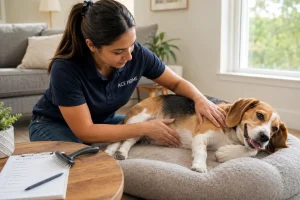
If your work schedule means your puppy will regularly be alone for six or more hours per day, a midday check-in is not optional — it is a genuine welfare requirement. This is one of the situations where a professional midday visit makes a concrete difference to how a dog develops, not just how they feel on a given afternoon.
Jacksonville-Specific: What Heat Does to the Equation
This is where Jacksonville creates conditions that most general dog care guides do not address. The inside of a home without functional air conditioning in Jacksonville’s summer is not a safe environment for a dog left alone for any significant length of time. But even with working air conditioning, there are scenarios every Jacksonville dog owner should think through.
Power outages
Florida’s storm season brings lightning, tropical weather, and occasional power outages that can last hours. A dog alone in a home that loses power on a July afternoon in Jacksonville can be in genuine distress — and potentially danger — within a shorter window than most owners would assume. Indoor temperatures in a sealed home without AC can climb significantly within two to three hours of power loss during summer.
This is not a reason to panic on every stormy day, but it is a reason to have a plan. Know what your dog’s options are if power goes out while you are away — a neighbor with a key, a friend nearby, or a professional contact who can check in and act if needed.
Water access throughout the day
Dogs left alone need consistent access to fresh water, particularly in Jacksonville’s heat and humidity. A single bowl that runs dry two hours into an eight-hour workday is a problem that compounds as the day goes on. Consider leaving multiple bowls in different rooms, or investing in a larger capacity water dispenser that your dog can access throughout the time you are away.
| Never assume your dog’s water situation is fine without checking at the end of the day. A bowl that is consistently running dry by midday is a signal to increase the available supply — and to shorten the time between check-ins during the warmer months. |
Separation Anxiety: When Time Alone Becomes Distress
A dog that is alone for six hours but emotionally settled is in a different situation than a dog that is alone for two hours but experiencing active anxiety for the full duration. Separation anxiety is not simply a dog that misses its owner — it is a state of genuine psychological distress that can involve destructive behavior, self-harm, incessant vocalization, house soiling despite being fully trained, and in severe cases, physical symptoms including vomiting or refusing to eat.
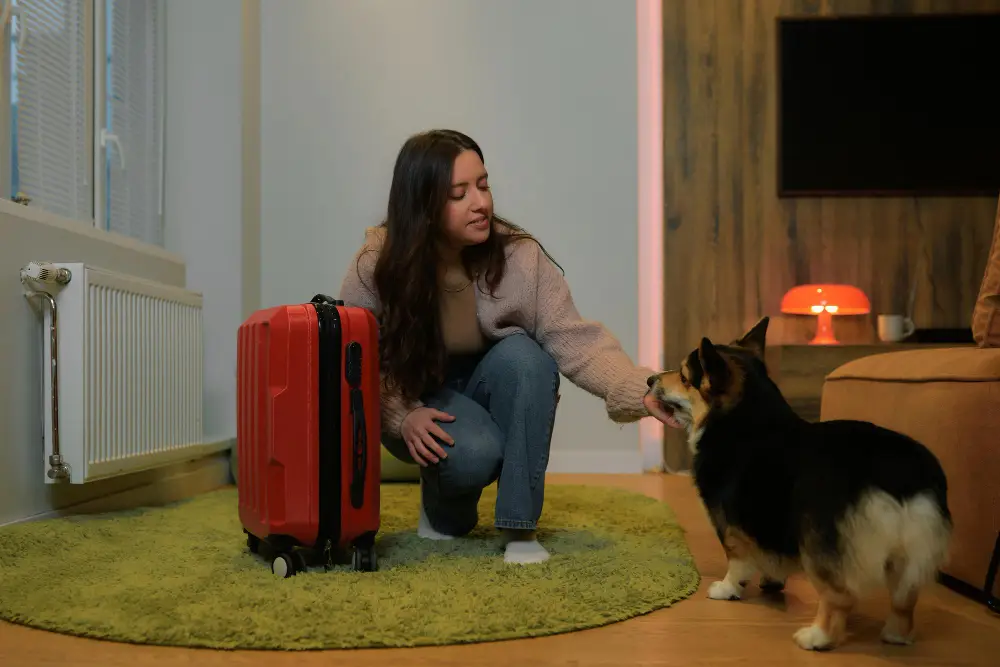
The signs of separation anxiety are usually visible in the first fifteen to thirty minutes after you leave. A camera set up to record your dog’s behavior in the hour after departure is one of the most useful tools for understanding whether your dog is settled once you go or whether they are in distress for the whole time you are gone.
What actually helps
Shortening the time alone is the most direct intervention, but it is not always immediately practical. In the meantime, a consistent pre-departure routine that your dog learns to associate with a calm, predictable pattern helps more than dramatic goodbyes or attempts to reassure a dog who is already escalating. A stuffed Kong or food-dispensing toy given just before you leave can redirect attention and create a positive association with your departure. Leaving background noise — a radio or television on a calm channel — can reduce the disorienting silence that some dogs find harder to manage than the absence itself.
For moderate to severe separation anxiety, behavioral intervention from a qualified trainer or veterinary behaviorist produces better results than management strategies alone. This is a clinical issue for many dogs, and addressing it seriously tends to produce better long-term outcomes than adjusting workarounds indefinitely.
Practical Options for Jacksonville Dog Owners
If your daily schedule regularly exceeds what your dog can comfortably manage alone, there are real options — none of which require reorganizing your entire life.
A midday check-in or dog walk
A thirty to sixty minute midday visit from a professional breaks up the day’s longest gap. For a dog that maxes out at five or six hours, a midday walk at around noon means the longest stretch alone is three to four hours on either side — a fundamentally different experience from eight consecutive hours with no contact.
Dog daycare for longer days
On days when your schedule is unpredictable or extended, daycare provides structured care and company for the duration. It is not necessary every day for every dog, but for dogs that struggle with isolation or have high social and physical needs, it is a more appropriate option than leaving them alone for ten or eleven hours.
A neighbor or trusted contact with a key
For owners who cannot arrange professional midday care consistently, a trusted neighbor who is willing to check in occasionally provides at least a baseline safety net — particularly valuable during storm season when power outages are a realistic scenario.
| The most important variable is not the total time alone but whether that time is reasonable for your specific dog’s age, health, and temperament. A calm, settled four-year-old dog can handle six hours alone with far less impact than an eight-month-old puppy left alone for the same stretch. |
The Honest Answer
There is no single number that applies to every dog in every situation. What the research and veterinary consensus consistently points toward is this: most adult dogs should not regularly be alone for more than six to eight hours, puppies need check-ins far more frequently, and the gap between manageable and problematic varies enough between individual dogs that owners need to pay attention to their specific animal rather than relying on a general rule.
In Jacksonville, the heat adds a layer of practical consideration that owners in cooler climates do not have to factor in. Between the climate, the storm season, and the power outage risk, a midday check-in is not just about your dog’s company — it is often a genuine welfare measure during the months when Florida makes its presence felt most forcefully.