How a dog’s relationship with a new sitter begins largely determines how that relationship develops. An introduction that goes well — where the dog has time to investigate, where the sitter behaves in ways the dog can read as non-threatening, where nothing is forced — produces a working arrangement that becomes easier with every visit. An introduction that goes badly, or is skipped entirely, produces something the dog and the sitter spend weeks trying to recover from.
This guide covers the introduction process from the dog’s perspective outward — what dogs need in order to accept a new person into their home environment, what body language to read during the meeting, and how to manage introductions for dogs who find new people difficult. It applies to any new pet sitting arrangement in Jacksonville, whether that is daily walks, periodic check-in visits, or extended vacation care.
Why the Introduction Process Matters More Than Most Owners Realize
From a dog’s perspective, a pet sitter is a stranger who enters their territory and then is suddenly expected to handle them, feed them, and walk them without prior relationship context. Dogs are not automatically accepting of this. They use the introduction meeting to gather information — scent, body posture, movement patterns, tone of voice — and the conclusions they draw from that meeting inform every subsequent visit.
An owner who brings in a new sitter without a proper introduction, or who rushes through a greeting and leaves immediately, is asking their dog to adapt without the information they need to feel safe. The anxiety that some dogs show in the early weeks of a new sitting arrangement is often not about the sitter at all — it is about an introduction that did not give the dog enough time to process the relationship before they were left alone with this new person.
| Dogs do not understand social contracts. They do not know that the person entering their home has been hired, vetted, and trusted by their owner. They know that a new person has entered their territory, and they need time to assess whether that person is safe. The introduction process is how you give your dog that time. |
Reading Your Dog During the Introduction
The most valuable thing an owner can do during the meet-and-greet is observe their dog — not the sitter. What your dog’s body is doing during the introduction tells you whether the meeting is going at the right pace, whether the sitter’s approach is landing well, and whether something needs to slow down or stop entirely.
| Signal | What It Usually Means | What to Do |
| Loose, wiggly body — tail at mid-height or below | Relaxed, open to interaction | Allow approach; meeting is going well |
| Sniffing calmly, brief eye contact then looking away | Processing, cautiously positive | Let it continue; do not rush toward greeting |
| Tail tucked, head low, moving away or behind owner | Uncomfortable, seeking distance | Ask sitter to lower posture, look away, let dog approach |
| Stiff body, hard stare, tail high and still | Tension — escalation risk if pushed | Pause the introduction, give space, do not crowd |
| Whale eye (whites visible), ears pinned flat | Fear or anxiety — stress response | Slow down immediately, give dog more distance from sitter |
| Growling or showing teeth | Active warning — boundary being communicated | Do not correct or punish. Give distance. Do not force interaction |
| Approaching sitter voluntarily, sniffing hands | Comfortable, building confidence | Positive sign — still allow dog to set the pace |
| Relaxed play bow or soliciting attention | Fully comfortable, intro is succeeding | Natural interaction can follow at the dog’s invitation |
The critical point with the stress signals — tucked tail, whale eye, stiff body, growling — is that they are information rather than problems to be corrected. A dog showing stress during an introduction is telling you the pace is too fast or the approach is too direct. The response is to give space, slow down, and allow the dog to move toward comfort at their own pace. Correcting a stress signal teaches the dog that their communication is not effective, which does not make them more comfortable — it removes the early warning.
What to Ask Your Sitter to Do During the Introduction
The owner’s role during the introduction is to observe. The sitter’s role is to be predictable, calm, and non-pressuring. Most of the introduction mistakes that happen in the first meeting are sitter-side — well-intentioned behaviors that dogs read as threatening or overwhelming.
Ask the sitter to avoid direct frontal approach
Walking directly toward an unknown dog, making direct eye contact, and immediately reaching toward them is standard human greeting behavior. It is the opposite of what dogs find comfortable. A sitter who understands this will approach at a slight angle, avoid sustained eye contact, and allow the dog to make the first move toward physical contact. If your sitter instinctively does the correct thing without being asked, that tells you something positive about their experience with dogs. If they need to be told, tell them — it is a simple adjustment that makes the introduction measurably better.
Ask the sitter to let treats be your dog’s idea
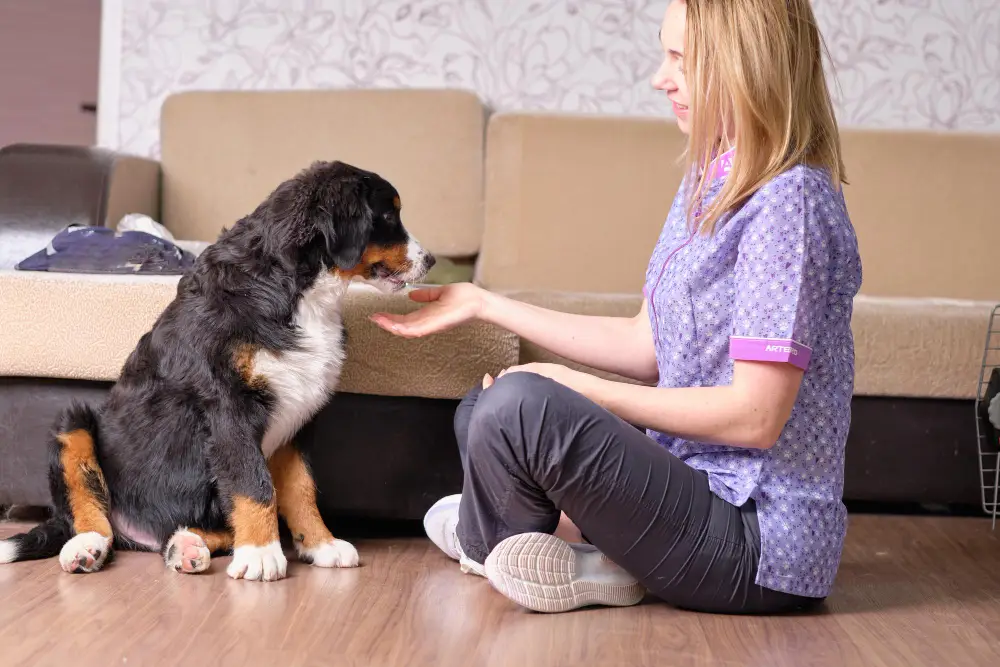
Offering a treat to a dog during the introduction is reasonable. Pursuing the dog with a treat, following them as they move away, or putting a treat directly in front of a retreating dog is not. The correct technique is to drop a treat on the ground near the dog and step back — allowing the dog to move toward the food on their own terms, creating a positive association without creating pressure. A sitter who immediately understands this distinction is showing you dog literacy that matters.
Ask the sitter to move slowly and keep their voice low
High-pitched, excited greetings — ‘Oh hi, aren’t you a good boy!’ delivered with fast movement and direct leaning — are overwhelming for most dogs meeting a new person. A calm, low-voiced, slow-moving entry is what allows a dog to assess without triggering their startle or defensive response. This is particularly important for reactive or sensitive dogs, but it is genuinely better practice for any dog meeting a new person for the first time.
A Three-Stage Introduction for New Sitters
For most dogs, a single well-run meet-and-greet is sufficient to begin a sitting arrangement. For dogs who are more cautious, anxious, or have a history of difficult reactions to new people, a staged introduction across multiple visits produces significantly better outcomes than expecting the first meeting to carry all the relational weight.
Stage one — the owner-present meeting
This is the standard meet-and-greet. The sitter comes to your home while you are present, enters calmly, and allows the dog to approach on their own terms. The sitter does not attempt to pet the dog unless the dog has clearly invited it through approaching, sniffing, and showing relaxed body language. The visit lasts twenty to thirty minutes and ends before the dog shows any significant stress. No care responsibilities are handed over at this stage.
Stage two — the sitter visits while you are briefly absent
This stage bridges the gap between meeting the sitter with you present and being left alone with them entirely. The sitter arrives while you are home, settles in, and then you leave for thirty to sixty minutes — a short trip to the shops, a walk around the block. This gives your dog their first experience of being with the sitter without you present, under low-stakes conditions where nothing critical depends on it going perfectly.
When you return, observe your dog. Are they settled? Did they eat or drink normally while you were out? Did they interact with the sitter or spend the time hiding? The answers give you a realistic picture of how the first full visit will go, and the opportunity to adjust the approach before the stakes are higher.
Stage three — the first full care session
With stages one and two complete, the first full care session — whether that is a walk, a full-day visit, or overnight coverage — begins with a dog who has already met the sitter twice, has experienced being alone with them once, and has formed an initial impression that is based on real experience rather than forced familiarity.
Introducing Reactive or Anxious Dogs to a New Sitter
For dogs with known reactivity to strangers, significant anxiety, or a history of difficult reactions to new people entering their space, the three-stage approach above may need to extend further — and the sitter’s experience with reactive dogs becomes a specific competency to verify rather than assume.
Tell the sitter explicitly before the first meeting
A sitter who does not know they are meeting a reactive dog will approach it like any other introduction. A sitter who knows has time to prepare — they can arrive with high-value treats, adjust their body language before they enter, and calibrate their expectations for how the meeting will go. Telling your sitter that your dog is reactive or anxious around strangers is not a warning that should make you self-conscious. It is information that allows a professional to do their job better.
Ask specifically about their experience
‘Have you worked with reactive or anxious dogs before?’ and ‘What do you do if a dog won’t approach you or shows stress signals?’ are not trick questions. They are the questions that reveal whether the sitter understands that a reactive dog’s introduction requires patience and technique rather than persistence and optimism. A sitter who answers these questions specifically and confidently has experience to draw on. One who answers vaguely probably does not.
Do not rush the timeline
A reactive dog who has had a genuinely positive experience across three introduction visits is in a fundamentally different position than one who was left with a new sitter after a single difficult meeting. The additional time required to introduce a reactive dog properly is significantly less than the time required to repair a relationship that started badly.
| If your dog growls, snaps, or shows clear fear during the introduction and the sitter’s response is to push through it — continue approaching, ignore the signal, or suggest the dog will ‘get used to it’ — that response is a significant indicator of the sitter’s dog literacy. A dog communicating discomfort through stress signals needs those signals honored, not overridden. |
Your Body Language Matters Too
Dogs read their owners constantly and draw conclusions from what they observe. An owner who is tense, anxious, or who is hovering protectively during the introduction communicates to their dog that something about this situation warrants concern. An owner who is calm, engaged neutrally, and moving normally around the home communicates the opposite.
This is not about performing calmness you do not feel — it is about understanding that your dog is using your behavior as a reference point. If you are visibly anxious about how the introduction will go, your dog is more likely to be anxious about it too. The practical advice is simple: greet the sitter normally, move around the house at your regular pace, and trust the introduction process rather than managing it too heavily. The dog will take their cue from you.
A Good Introduction Is an Investment
The time spent on a proper introduction — two or three visits across a week or two rather than a single rushed meeting — is not overhead. It is the foundation on which every subsequent visit builds. A dog who has been properly introduced to their sitter arrives at each visit with a relationship context that makes the care itself easier, calmer, and more effective.
For Jacksonville pet owners who rely on professional care while they work, travel, or manage the demands of a full schedule, that foundation is worth building correctly. A well-introduced dog who is genuinely comfortable with their sitter is an owner who can leave the house without the low-level anxiety that an uncertain pet care arrangement produces.