Every pet owner arrives at the cost question eventually. You have been managing with a neighbor, a gig app, or the periodic scramble of asking whoever is available. You are looking at what professional in-home pet care costs and wondering whether the difference in price reflects a difference in outcome that actually matters for your pet and your life.
The honest answer is: it depends on your situation, your pet, and what you are currently using instead. This is a direct look at when in-home pet care is clearly worth what it costs, when it represents a genuine improvement over lower-cost alternatives, and when the existing arrangement is adequate and the premium is not justified.
What You Are Actually Comparing
The worth-it calculation for in-home pet care is not a comparison against a free option. It is a comparison against whichever alternative you are currently using — a neighbor, a kennel, a gig platform, or periodic self-management. Each of those has a real cost in money, reliability, and pet welfare outcomes, even when the monetary cost is zero.
| Alternative | Typical Cost | What It Typically Lacks | When It Makes Sense |
| Neighbor or friend | Free or low-cost | Insurance, emergency protocol, professional backup, reliable schedule | Simple healthy pets, genuinely dependable relationship, short trips |
| Kennel / standard boarding | $30–$60/night | Home environment, routine continuity, individual attention, illness isolation | Dogs comfortable in group settings, owner who wants 24/7 facility staff |
| Gig app (Rover, Wag) | $15–$35/visit + 15–25% fee | Carer consistency, local knowledge, accountability, relationship continuity | Budget owners comfortable managing sitter-to-sitter inconsistency |
| Pet-friendly hotel travel | Trip cost + pet fees | Only works for some destinations; not all pets travel well | Road trips, pet-friendly destinations, well-travelled dogs specifically |
| Leaving pet alone | Free | Daily needs unmet; welfare concern for dogs beyond 6–8 hours | Adult cats for 1 day maximum; never appropriate for dogs regularly |
| Professional in-home care | $18–$85 per visit/night | Nothing removed — this is the full-service option | Most households; pets with specific needs; owners who value consistency |
The table above is not an argument that every alternative is inadequate. A neighbor who is genuinely dependable, knows your pet well, and is capable of handling an emergency competently is a legitimate pet care arrangement for many households. The point is that the comparison to in-home professional care should account for what each option actually delivers — not just what each costs on the day.
Where In-Home Pet Care Delivers Its Clearest Value
Pets with specific needs
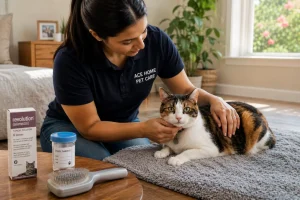
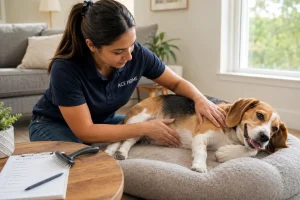
The case for professional in-home care is strongest for pets who require more than routine feeding and a potty break. A dog on daily medication, a cat with a chronic condition, a senior animal whose health can change quickly, or a pet with anxiety that makes unfamiliar environments genuinely distressing — these are situations where the consistency, accountability, and competency of a professional arrangement produce meaningfully better outcomes than alternatives that do not prioritize any of those things.
A neighbor who agrees to check in twice a day is not the same resource as a professional carer with a pre-agreed emergency protocol, your vet’s direct contact, and the experience to recognize when something is off before it becomes urgent. For healthy animals with straightforward needs, that gap may not matter. For medically complex pets, it matters significantly.
The accumulating relationship value
One of the least-discussed benefits of professional in-home care is what builds over time rather than what is present from session one. A carer who has been working with your dog or cat for six months knows their baseline so well that a subtle behavioral change — slightly less interested in food, moving a little differently, less engaged than usual — registers as worth flagging. A new sitter or a rotating gig app worker has no baseline to compare against.
This relationship value accumulates invisibly. It is not listed on any invoice. But for pet owners who have used consistent professional care long enough to experience it, the carer who says ‘your dog seemed a little flat today, might be worth keeping an eye on’ and turns out to be right is providing something that cannot be replicated by the cheapest option available.
Owner Peace of Mind Is a Real, Measurable Benefit
The value of not worrying about your pet while you are at work, traveling, or simply away from home for the day is not sentimental — it is practical. An owner who is genuinely confident their pet is well cared for is not checking their phone every hour, not cutting meetings short to get home, and not carrying low-grade anxiety through a day or a trip that costs more than the pet care itself to manage.
What that anxiety actually costs
Consider a working professional in Jacksonville who is not confident in their current pet care arrangement. They leave later in the morning to minimize alone time, they arrange their schedule around getting home earlier than they need to, and they cut a four-day business trip to three days because they are not sure the arrangement will hold for the fourth night. The accumulated cost of those decisions — in professional opportunity, in schedule disruption, in the trips not taken — can easily exceed the annual cost of reliable professional care.
This is not an argument to spend money on pet care that your situation does not require. It is an argument that the calculus around cost should include what you give up by not having a reliable arrangement, not just what the arrangement itself costs.
| The most useful measure of whether in-home pet care is worth it is not whether the rate feels high — it is whether you actually stop thinking about your pet when you are not with them. If a care arrangement produces genuine confidence rather than managed worry, the rate it charges is earning its value. |
The Home Security Benefit — Concrete and Underappreciated
An occupied home is a different proposition from an empty one. A professional carer present in or around your property during a trip creates a visible pattern of activity — lights on at normal times, a car in the drive periodically, someone clearly present — that an empty home does not produce. This is not the primary reason to use in-home pet care, but it is a concrete additional benefit with real monetary value.
Jacksonville’s residential neighborhoods vary considerably in their security profiles, and a home that is visibly empty for a week during a holiday period is in a different risk category from one that appears occupied. For owners who travel regularly and have considered home security services as an additional expense, it is worth noting that a professional in-home care arrangement provides a meaningful portion of that benefit as a byproduct of the primary service — with no additional cost.
When In-Home Care Is Genuinely Not Worth It
An honest answer to this question includes the scenarios where professional in-home care represents more than the situation requires.
Pets whose needs are genuinely simple and already covered
An adult cat with no medical needs, a settled temperament, and a genuinely dependable neighbor who visits daily, knows the cat well, and has your vet’s number is a situation where professional care adds cost without adding proportionate value. If the existing arrangement works — meaning the cat is healthy, the neighbor is reliable, and you do not lie awake worrying about the arrangement — there is no case for changing it.
Very short absences
For absences of a day or less, a healthy adult cat or a dog with excellent bladder control and access to water can manage without professional care in most cases. The threshold below which in-home care adds genuine value is roughly the point at which your pet’s physical needs cannot be met without intervention during your absence. Below that threshold, the cost may not be justified.
Owners with genuinely reliable informal networks
Some pet owners have access to family members, close friends, or neighbors with genuine competency, genuine availability, and a real relationship with their pets. Where that exists, it is a legitimate alternative to professional care for routine situations. The limitation of informal networks shows up at the edges — the family member who is usually available but gets sick the day you fly out, the neighbor who is reliable for a weekend but not for two weeks, the friend who means well but does not know what to do if something goes wrong.
| The informal network test: would the person you are relying on know what to do at 10 PM if your dog stopped eating, started vomiting, or was clearly in pain? If the honest answer is no — or ‘they would call me and I would try to figure it out from a different country’ — the informal network has a gap that professional care fills. |
The Net Cost — Not Just the Invoice
The most rigorous way to answer the worth-it question is to calculate what in-home care costs net of what it prevents. This is not an exercise most pet owners go through explicitly, but the components are real.
A dog that receives regular professional walking and daycare is less likely to develop the behavioral problems that accumulate in under-exercised animals. Behavioral training for problems rooted in under-exercise costs several hundred to several thousand dollars and is frequently less effective than simply meeting the need before the problem develops. A cat that is monitored daily by a professional carer is more likely to have a urinary issue or early illness caught at a stage that costs less to treat than one discovered at a later stage.
None of this means professional care eliminates veterinary costs or that the savings are guaranteed or calculable in advance. It means that the line on the invoice is not the complete picture of what professional care costs when it is working well — and that some portion of what it prevents is financial rather than purely welfare-related.
The Answer for Most Jacksonville Pet Owners
For most Jacksonville pet owners who own dogs requiring daily care and use professional services more than occasionally, in-home pet care is worth the cost. The combination of consistent professional standards, accumulated relationship knowledge, owner peace of mind, and the concrete welfare benefits of reliable daily care represents genuine value that lower-cost alternatives provide only partially or intermittently.
For cat owners using occasional visit care, and for owners with genuinely reliable informal networks covering straightforward pets, the calculation is more situational. The worth-it test is simple: does your current arrangement produce genuine confidence, or managed anxiety? If it is the latter, the cost of a professional arrangement is almost certainly less than what the anxiety is already costing you.