Dog hotels have changed what pet care looks like in a lot of cities. What used to be a straightforward choice between leaving a dog with a neighbor or dropping them at a kennel now includes a third category — luxury boarding facilities with private suites, webcam access, enrichment programs, grooming add-ons, and the visual language of a boutique hotel applied to pet care. Jacksonville has options in this space, and for some dogs and some owners, they are genuinely useful.
But the proliferation of upscale branding can make it harder, not easier, to figure out what you are actually buying. This is a clear-eyed comparison of what dog hotels offer, what in-home overnight care offers, and how to decide which one is the better choice for your specific dog.
What a Dog Hotel Actually Is
A dog hotel is a boarding facility positioned at the premium end of the market. Rather than the traditional kennel model — runs, group areas, basic feeding and care — a dog hotel offers private or semi-private suites, often furnished with elevated beds and décor, structured activity programming, and premium add-ons like grooming, massage, or training sessions.
The core experience is still a facility-based one. Your dog leaves your home, goes to the hotel’s location, and spends the duration of your trip in a space that is not their own. The suite may be comfortable and attractive by any reasonable measure, but it is still an unfamiliar space, staffed by people your dog has likely never met, in a building shared with other animals. The premium is in the quality of the facility and the caliber of the amenities — not in the fundamental nature of what the experience is for your dog.
| A dog hotel can be a genuinely excellent option for the right dog. Understanding what the premium actually buys — and what it does not — is what makes the decision an informed one rather than a marketing-driven one. |
Side-by-Side: Dog Hotel vs In-Home Overnight Care
| Factor | Dog Hotel / Luxury Boarding | In-Home Overnight Care |
| Location | Facility outside the home | Your pet’s own home |
| Sleeping environment | Luxury suite, private room, or group area at facility | Your pet’s own bed in their own space |
| Attention model | Staff split across multiple guests | One carer dedicated to your household |
| Social environment | Other dogs present; can be stimulating or stressful | No other animals; controlled, familiar environment |
| Daily routine | Facility schedule — group activities, set meal times | Your pet’s established routine maintained precisely |
| Illness risk | Higher — shared spaces, shared staff contact | Minimal — single household environment |
| Cost range | $60–$150+ per night depending on suite tier | $75–$90 per night depending on duration |
| Luxury feel | High — amenities, webcams, grooming add-ons | No frills — comfort is the familiar home itself |
| Best suited for | Social, confident dogs comfortable in new environments | Most dogs — especially anxious, older, or home-oriented pets |
| Booking flexibility | Advance booking often required; holiday waitlists | Similar — early booking recommended for peak periods |
What Dog Hotels Do Well
Social dogs in a stimulating environment
For dogs that are genuinely social, confident around other animals, and energized by novelty rather than stressed by it, a well-run dog hotel can be a rich experience. Group play sessions, interaction with other dogs, and a consistent stream of activity suits certain temperaments extremely well — particularly younger, high-energy breeds that find a quiet home environment understimulating.
Webcam access and structured updates
Many dog hotels offer webcam access so owners can check in visually on their pet throughout the day. For owners whose primary concern is being able to see their dog rather than relying on a sitter’s report, this is a meaningful differentiator. The visibility is genuine and real-time, which some owners find considerably more reassuring than photo updates sent at the sitter’s discretion.
Staff availability around the clock
A facility with overnight staff present continuously is different from an individual sitter who is asleep in your home. If your dog has a medical episode at 2 a.m., a hotel with staff on shift is positioned to respond immediately without the variable of waking someone from sleep. For dogs with known health conditions where rapid response matters, this is worth considering in the comparison.
What In-Home Overnight Care Does Well
The home itself is the comfort
The single most significant advantage of in-home overnight care is not about the quality of the carer — it is about the environment. Your dog already knows your home. They know where to go when they are nervous, where their bed is, what the house sounds like at night, and what the smells are. That familiarity is not a small thing for an animal whose sense of security is profoundly tied to their territory.
A dog hotel’s suite may be objectively comfortable — orthopedic bed, climate control, tasteful décor. But it is still a room your dog has never slept in, in a building full of unfamiliar sounds, staffed by people your dog does not know. The luxury of the environment does not undo the fact that it is unfamiliar, and for many dogs, unfamiliar and comfortable are not the same thing.
One-to-one attention and zero competition
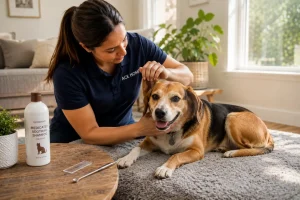
In-home overnight care means the carer is there for your household specifically. There are no other dogs competing for attention, no facility schedule to work around, no shared outdoor time where your dog’s individual needs get averaged into a group activity. Every feeding, every walk, every moment of attention is organized entirely around what your pet needs.
A dog hotel with twenty guests and four overnight staff is operating at a different attention ratio. Most well-run hotels manage this adequately — but adequately is different from exclusively. The difference becomes most visible with dogs that have specific behavioral needs, medical requirements, or temperaments that genuinely require individualized handling.
Routine continuity
Your dog eats at the times they always eat, goes outside when they usually do, sleeps where they always sleep, and interacts with the same familiar objects in the same familiar layout. A dog hotel’s schedule is the hotel’s schedule, adapted as reasonably as possible for each guest but fundamentally organized around the facility’s operations rather than any individual animal’s established pattern.
For dogs whose wellbeing is closely tied to predictable routine — older animals, those with anxiety histories, or pets that have taken a long time to establish stability — this is one of the clearest arguments for in-home care over any facility-based alternative, regardless of how well that facility is run.
| The quality of dog hotels varies significantly in Jacksonville and across Florida generally. A hotel with premium branding and appealing photography is not necessarily operating at a higher standard of actual care than a simpler facility. Before booking any dog hotel, ask specifically about staff-to-guest ratios during overnight hours, emergency protocols, and how they handle a dog that is showing signs of stress or illness. |
What the Cost Comparison Actually Looks Like
Dog hotel pricing in Jacksonville varies considerably depending on the tier of suite, the add-ons selected, and the facility’s positioning in the market. Basic suite rates tend to start around sixty to eighty dollars per night at the lower end of the luxury segment and can exceed one hundred and fifty dollars per night for premium suites with additional services.
In-home overnight care from a professional insured sitter in Jacksonville typically runs between seventy-five and ninety dollars per night for a standard stay, with slight reductions for extended bookings. At comparable price points, in-home care and a mid-tier dog hotel suite are often within a few dollars of each other per night.
The meaningful cost difference tends to appear when comparing a fully loaded dog hotel stay — premium suite, webcam, structured activity package, grooming session — against a straightforward in-home arrangement. The hotel stay costs more in those cases. Whether the additional cost reflects additional value for your specific dog is the question worth answering before booking.
Which Option Suits Your Dog?
The most useful framing is not which option is better in the abstract — it is which option is better for your specific dog’s temperament, health, and history.
Dog hotels tend to work better for dogs that
Are well-socialized, confident around unfamiliar people and animals, and experience novelty as stimulating rather than stressful. Young, high-energy breeds that genuinely benefit from the group play and activity structure a good hotel provides. Dogs whose owners’ primary concern is real-time visual access and facility-level emergency response capability.
In-home overnight care tends to work better for dogs that
Are strongly home-oriented, easily stressed by environmental change, older, or have medical needs requiring precise, individualized management. Dogs that have had difficult experiences in group or facility settings. Cats — almost universally, cats do better in their own environment than in any facility regardless of how well that facility is run. Multi-pet households where each animal has different requirements that a facility cannot feasibly tailor to.
Making the Decision
Both options can be high quality, professionally run, and appropriate for the right animal. The most reliable way to decide is to assess your dog’s actual temperament honestly — not based on what you hope they would enjoy, but on what you have observed when they encounter new environments, new people, and unfamiliar animals.
A dog that has always found novelty stressful does not become a good candidate for a dog hotel because the suite has a better bed. A dog that thrives in social environments and bounces back quickly from new situations may find in-home care quieter than they actually want for an extended stay. Match the option to the dog, and the decision usually clarifies itself.