Jacksonville receives approximately 53 inches of rain annually — more than Seattle, more than New York, more than almost any city in the continental United States. The vast majority of that rainfall lands between June and September, concentrated in the afternoon thunderstorm pattern that defines the city’s summer climate. For pet owners, this is not just a walking schedule inconvenience. Rainy season in Jacksonville creates a four-month window of elevated parasite risk, specific health hazards, storm-related behavioral challenges, and daily management decisions that dry-season routines do not prepare you for.
Here is what Jacksonville pet owners need to understand about managing their pets’ health, safety, and daily routine through rainy season — from lightning protocol to leptospirosis to what prolonged wet coats actually do to skin health.
Understanding Jacksonville’s Afternoon Storm Pattern
The daily summer storm cycle in Jacksonville follows a remarkably consistent pattern. Most afternoons between roughly 2 p.m. and 6 p.m., the combination of sea breeze convergence and accumulated daytime heating produces thunderstorm development that moves through Duval County quickly and with significant lightning, heavy rain, and occasional localized flooding.
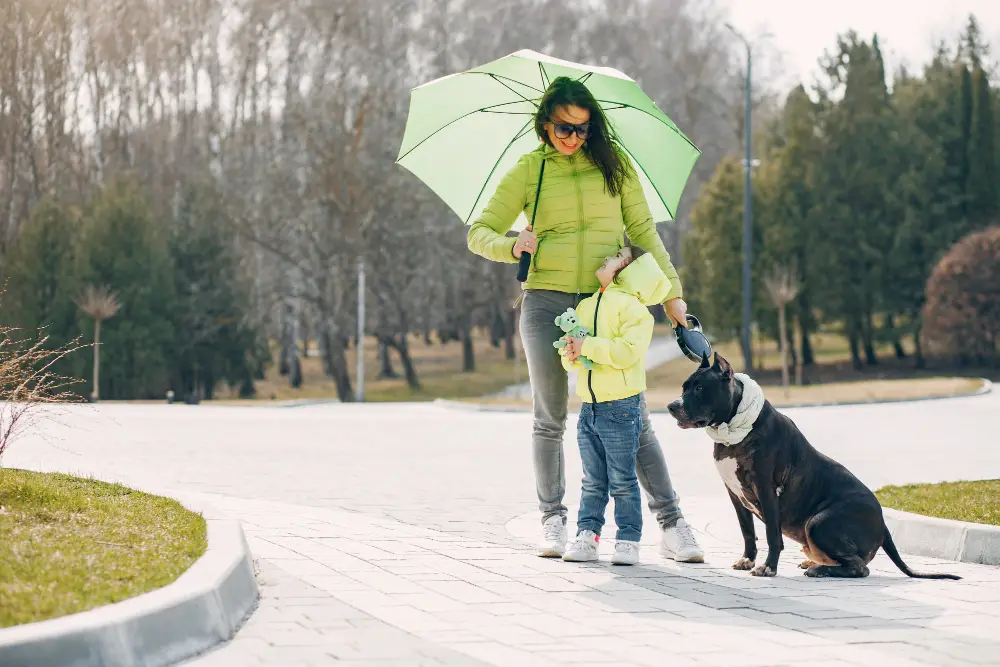
For pet owners, the practical implication is that outdoor activity planned for the afternoon needs to be either completed before 1 p.m. or rescheduled for after 6 p.m. This is not about avoiding getting wet — it is primarily about lightning safety and the specific hazards that standing water and post-storm environments create.
Lightning safety on walks — the 30-30 rule
Lightning is the rainy season’s most acute safety hazard for outdoor activity. The 30-30 rule provides a practical threshold: if the time between a lightning flash and the accompanying thunder is thirty seconds or less, the storm is within six miles and outdoor activity should stop immediately. Seek shelter in a substantial building or a hard-topped vehicle — not under trees, not in open park structures, and not in areas near water. Wait thirty minutes after the last audible thunder before resuming outdoor activity.
Dogs are not immune to lightning strike risk. They are typically lower to the ground than humans and may be in areas — open parks, retention pond edges, treelines — that increase exposure. If you are caught outdoors during a sudden storm, avoid tall objects and bodies of water, crouch low if you cannot reach shelter immediately, and keep the dog close to you.
| In Jacksonville’s rainy season, checking a weather radar app before any afternoon outdoor activity is not paranoia — it is basic planning. A storm that is visible on radar twenty miles away can be overhead in fifteen minutes. Build the radar check into your afternoon walk preparation as a habit. |
Rainy Season Parasite and Infection Risk — Jacksonville’s Specific Hazards
Jacksonville’s combination of warm temperatures and sustained rain creates optimal conditions for multiple parasites and pathogens that pose genuine health risks to dogs and cats. Rainy season is not when these risks begin — Florida’s climate means year-round parasite pressure — but it is when they intensify significantly.
| Parasite / Risk | Why Rainy Season Increases Risk | Prevention |
| Mosquitoes / Heartworm | Standing water multiplies breeding sites exponentially; mosquito pressure increases dramatically June–September | Monthly heartworm prevention — non-negotiable in Florida year-round |
| Fleas | Warm, humid conditions are optimal for flea development; eggs hatch faster, populations build faster | Year-round topical or oral flea prevention; treat home environment if infestation found |
| Ticks | Wet grass and vegetation create ideal tick habitat; activity increases in tall wet grass post-rain | Year-round tick prevention; check ears, groin, between toes after outdoor time |
| Leptospirosis | Bacteria shed in wildlife urine — floods and puddles concentrate leptospira in standing water dogs encounter | Leptospirosis vaccine — discuss with vet; annual or biannual booster for Jacksonville dogs |
| Hookworms / Roundworms | Larvae survive longer and spread further in wet, warm soil; bare-soil areas in parks become higher-risk post-rain | Year-round deworming protocol; avoid bare-soil areas with standing water post-rain |
| Ringworm (fungal) | Prolonged wet coat and damp skin create conditions for dermatophyte fungi — not a worm, a fungal infection | Dry coat thoroughly after rain; check for circular hair loss patches post-rainy season |
Leptospirosis — the rainy season disease most Jacksonville owners have never heard of
Leptospirosis deserves specific attention because it is both a genuine risk in Jacksonville’s rainy season environment and one of the least-discussed pet health topics in this region. Leptospira bacteria are shed in the urine of infected wildlife — rats, raccoons, opossums, and white-tailed deer, all of which are common in Jacksonville’s residential and park environments. During rainy season, floodwater and puddles concentrate these bacteria in standing water that dogs routinely sniff, lick, and walk through.
The disease causes kidney and liver failure in dogs and can be transmitted to humans, making it a zoonotic concern for entire households. The leptospirosis vaccine is not part of the standard core vaccination set — it is a non-core vaccine that must be specifically requested. Given Jacksonville’s rainy season conditions and wildlife exposure levels, many vets in the area recommend it for dogs with any regular outdoor exposure. If your dog’s veterinarian has not discussed leptospirosis vaccination, raise it directly during your next appointment.
What Prolonged Wet Coats Do to Your Dog’s Skin
A dog that gets wet and dries naturally — without toweling — is not a major concern on an occasional basis. A dog that is repeatedly wet and partially drying throughout a rainy season, day after day, develops skin conditions that a dry-season owner would not encounter.
Hot spots and moisture dermatitis
Hot spots — areas of acute moist dermatitis — develop when moisture is trapped against the skin by a wet coat, creating conditions where bacteria proliferate rapidly. They appear as red, raw, oozing patches that expand quickly and are extremely uncomfortable for the dog. Long-coated breeds, dogs with dense undercoats, and those with skin folds are at highest risk. Any area where water pools — under the collar, along the neck, behind the ears, between the legs — is a potential hot spot location during rainy season.
The prevention is straightforward: towel-dry thoroughly after every wet exposure. Pay particular attention to the neck and collar area, the base of the ears, the armpits, and the skin folds if your dog has them. If a hot spot develops — rapidly expanding, the dog is licking or biting at it — contact your vet. Hot spots left untreated grow quickly and can become significantly infected.
Ear infections in dogs with floppy ears
Dogs with pendant or floppy ears — Labrador retrievers, golden retrievers, spaniels, basset hounds — accumulate moisture in the ear canal after any water exposure. This warm, moist environment is ideal for yeast and bacterial growth. Rainy season, with its frequent wet exposure, is peak ear infection season for these breeds in Jacksonville. Dry the outer ear with a clean towel after every wet exposure. If your dog is shaking their head, scratching at an ear, or if you notice discharge or odor, have the ear checked promptly — ear infections that progress become significantly more uncomfortable and expensive to treat.
Paw Care During Rainy Season
Paw fungus from prolonged moisture
Dogs whose paws are repeatedly wet without adequate drying time between exposures can develop a yeast or fungal overgrowth between the toe pads — producing redness, swelling, and characteristic corn-chip odor. Check between the toes regularly during rainy season, particularly for breeds that lick their paws, and dry the paws — including between toes — after every wet outing.
Post-rain walk hazards
Standing water in Jacksonville post-rain is not clean water. It contains runoff from lawns (pesticides and fertilizers), drainage from roads (oil, heavy metals), and in some areas, overflow from aging sewer infrastructure. Dogs that walk through standing water and then lick their paws are ingesting these contaminants — a quick rinse and towel-dry after walks in wet conditions significantly reduces this exposure. This is distinct from the floodwater hazard covered in the context of hurricane events — this is the ordinary post-afternoon-storm puddle that is easy to overlook.
Managing Storm Anxiety During Rainy Season
A dog with thunderstorm anxiety during rainy season faces a four-month window of near-daily triggers. What might be manageable as an occasional event — a dog who is uncomfortable during storms but recovers quickly — can become a chronic stress pattern when storms occur five days out of seven for weeks at a time.
Signs that rainy season is affecting your dog’s baseline
Dogs with storm anxiety often begin showing stress responses before the storm is audible — they detect barometric pressure changes and develop anticipatory anxiety. During rainy season, this can manifest as a dog that begins showing anxiety behaviors in the early-to-mid afternoon regardless of whether a storm actually develops. If your dog’s afternoon behavior has shifted during rainy season — panting, pacing, seeking hiding spots without apparent cause — the storm pattern is likely the driver even when no storm is visible.
Managing the rainy season anxiety pattern
For dogs whose storm anxiety is mild to moderate, several approaches help. Providing a consistent safe space — a specific interior room or crate that is their designated storm shelter — allows the dog to self-regulate by retreating to a familiar location. Maintaining the routine, including meal and walk timing, provides the predictability that anxious dogs depend on. Reducing the dog’s exposure to storm cues — drawing blinds to minimize lightning flash, keeping the environment calm — reduces input without eliminating exposure.
For dogs with severe rainy season storm anxiety — those who injure themselves trying to escape, who become unmanageable, or whose anxiety is significantly affecting their quality of life across a four-month period — a conversation with your veterinarian about anxiety medication during rainy season is appropriate. Situational medication during rainy season is not a permanent commitment — it is a targeted intervention for a defined seasonal challenge.
| Do not punish a dog for storm anxiety behaviors — hiding, panting, trembling, or seeking contact. Punishment increases anxiety without addressing the cause. Attempting to force a visibly distressed dog out of a hiding spot or into a situation they find overwhelming during a storm makes the anxiety worse, not better. |
Rainy Season Is a Season, Not an Inconvenience
Four months of afternoon storms, saturated ground, elevated parasite pressure, and daily wet-exposure management is a meaningful shift in what responsible pet care looks like. The owners who navigate Jacksonville’s rainy season without incident are the ones who built the relevant habits before June — the leptospirosis conversation with the vet, the towel-dry routine after walks, the radar check before afternoon outdoor time, the storm anxiety plan for a dog who struggles.
None of these adjustments are burdensome individually. Together, they represent the difference between a rainy season that passes without health issues and one that produces a vet visit — or several — that thorough seasonal preparation would have prevented.