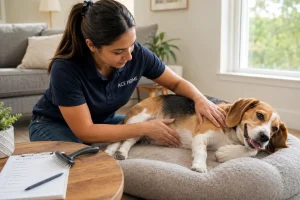
Pet medication administration is one of the most consequential things a pet owner or carer does, and one of the most casually approached. A medication course that ends two days early because the dog ‘seemed fine,’ an insulin dose given without confirming the cat has eaten, a pill that the dog appears to swallow but quietly deposits in the corner — each of these has medical implications that range from reduced effectiveness to genuine medical emergency depending on the specific drug and condition involved.
This guide covers why medication compliance matters enough to take seriously, how to administer the most common types of pet medications effectively, and how to structure the information handoff between a pet owner and a carer so that nothing about a medicated pet’s needs is lost in the transition.
Why Medication Compliance Is a Medical Issue, Not an Inconvenience
The consequences of missed, skipped, or incorrectly administered pet medication vary significantly by medication type. For some drugs, a missed occasional dose is recoverable. For others, irregular administration is clinically dangerous. The table below covers the specific consequences for the medication categories that appear most commonly in households with medicated pets.
| Medication Type | What Happens When Doses Are Missed | Notes for Carers |
| Antibiotics | Incomplete course allows resistant bacteria to survive and re-establish — the infection returns, harder to treat | Complete the full course even if pet appears recovered |
| Seizure medication (e.g. phenobarbital, KBr) | Dropping blood levels lowers the seizure threshold — missed doses can trigger breakthrough seizures within hours or days | Never skip or delay; contact vet if dose is missed |
| Thyroid medication | Blood levels fluctuate causing hyperthyroid rebound or hypothyroid symptoms — consistency of timing is as important as consistency of dosing | Same time daily; split doses must be evenly spaced |
| Cardiac medication | Irregular administration creates dangerous gaps in arrhythmia or blood pressure control — sudden cardiac event risk increases | Never double dose to compensate — contact vet |
| Insulin (diabetic pets) | Missed dose leaves glucose uncontrolled; extra dose without adequate food causes hypoglycemia, which can be fatal | Must be paired with confirmed food intake; never dose a pet that has not eaten |
| Pain medication (NSAIDs) | Missed doses allow pain to build back to undertreated levels — and irregular dosing of NSAIDs can cause rebound GI irritation | Give with food; note any vomiting or appetite change |
| Steroids | Abrupt discontinuation after extended use can cause adrenal crisis — tapering schedules must be followed precisely | Tapering instructions are as critical as dose instructions |
| Never adjust a pet’s medication dose without veterinary guidance — including reducing a dose because the pet seems ‘better.’ Many conditions, particularly cardiac disease and epilepsy, are controlled precisely because the medication maintains a stable blood level. ‘Seeming better’ is often the medication working, not evidence the dose can be reduced. |
Administering Oral Medications — Techniques That Actually Work
For dogs — the concealment approach
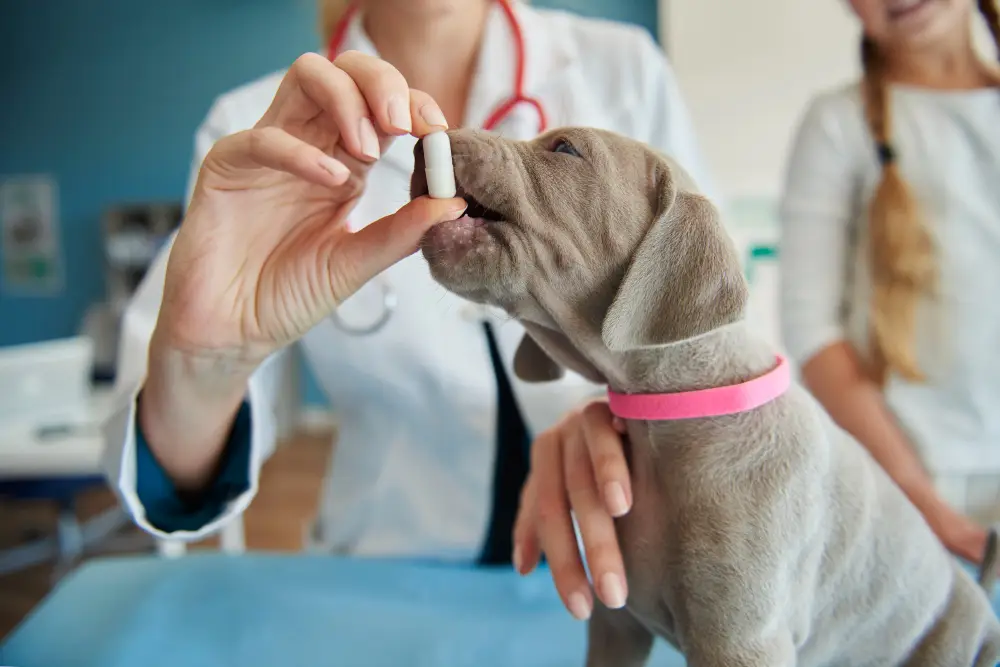
Most dogs can be pilled by concealing the medication in a small amount of a high-value food. Pill pockets are purpose-made for this. Soft cheese, a small amount of peanut butter without xylitol, cream cheese, or a piece of deli meat all work. The technique matters: offer a plain treat first, then the treat containing the medication, then immediately offer a second plain treat. The anticipation of the third treat is often enough to get dogs to swallow the second one quickly without investigating it.
Verify the pill has been swallowed. Watch the dog for thirty to sixty seconds — a dog working their tongue, repeatedly swallowing, or showing interest in the floor where they were standing has often retained the pill without swallowing it. Some dogs become expert at consuming the food wrapping and quietly depositing the pill. Developing a habit of checking — asking the dog to sit, looking in the mouth, or watching their behavior for a minute after dosing — prevents accumulated missed doses that neither the owner nor the carer realizes are happening.
For dogs — when concealment fails
Dogs that learn to extract the pill from any food wrapping, or that become suspicious of anything offered during medication time, can often be dosed with a pill gun — a plastic device that places the pill directly on the back of the tongue — followed immediately by a water syringe to encourage swallowing. This technique requires practice and works better when introduced gradually rather than as an emergency measure. Ask your veterinarian to demonstrate the technique at a standard visit if your dog is difficult to pill.
For cats — a different challenge
Cats are significantly more difficult to pill than most dogs. The direct approach — opening the mouth and placing the pill on the back of the tongue, then holding the mouth gently closed and stroking the throat — works for compliant cats and requires practice for resistant ones. A cat that is fighting the process, clawing, or vomiting the pill back up immediately is telling you the direct approach is not viable for them.
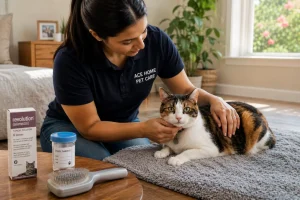
Compounding pharmacies can reformulate many medications into flavored liquid suspensions, treats, or transdermal gels applied to the inner ear flap — all of which dramatically improve compliance in cats that refuse oral pilling. If your cat’s medication is not available in an alternative form, ask your vet whether a compounded version can be prescribed. The cost difference is usually small and the compliance difference is frequently significant.
Liquid Medications, Eye Drops, and Ear Drops
Liquid oral medications
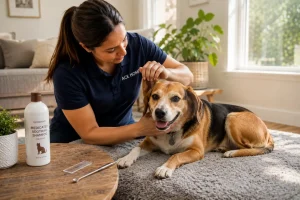
Liquid medications are administered via an oral syringe directed into the cheek pouch — the space between the teeth and the cheek, not straight down the throat. Directing liquid down the throat risks aspiration, particularly in cats and brachycephalic dogs. Administer slowly, allowing the pet to swallow between squirts. Have a treat ready to offer immediately after to create a positive association and clear any residual taste.
Ophthalmic and otic drops
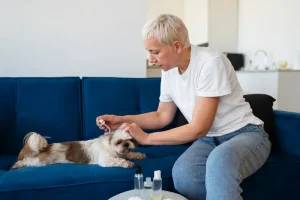
Eye drops and ear drops are easier to administer if the medication is at room temperature — cold drops cause more head-shaking in dogs and distress in cats, reducing the amount of medication that ends up where it belongs. Warm the bottle briefly in your hands before each dose. For eye drops, approach from the side rather than above — coming from above triggers a blink reflex that deflects the drop. For ear drops, massage gently at the base of the ear after administration to distribute the medication into the canal. Always reward immediately after — the association between medication administration and something positive reduces resistance over repeated doses.
Injectable Medications — What Carers Need to Know
Injectable medications in pets are most commonly insulin for diabetic animals. The technique for subcutaneous injection — pinching a tent of skin on the side of the neck or shoulder blade area, inserting the needle into the tent parallel to the body, and administering the dose — is straightforward to learn and requires a demonstration from the veterinary team before being handed off to any carer.
The critical rule for insulin administration is that it must always be paired with confirmed food intake. An insulin dose given to a pet that has not eaten causes hypoglycemia — a blood sugar drop that can be fatal without rapid intervention. A carer administering insulin should confirm the pet has eaten an appropriate amount of their normal food before dosing, every single time without exception. If the pet refuses food, the insulin dose should be held and the owner or vet contacted — not administered on schedule regardless.
Insulin must be stored refrigerated and used before its expiration date. A vial left out at room temperature degrades and loses potency at a rate that varies by formulation — some insulin types begin degrading within hours at room temperature. In Jacksonville’s summer power outages, refrigerated medications are a specific vulnerability that owners and carers need a plan for before the loss of power, not during it.
| Rotate subcutaneous injection sites — use a different spot within the safe injection area each time. Repeated injection in the same location causes tissue changes that reduce absorption and affect the medication’s effectiveness over time. A simple rotation pattern, noted on the medication chart, makes this easy to maintain consistently across different carers. |
The ‘What If’ Scenarios — A Decision Table for Carers
Medication administration situations arise that are not covered by the standard dosing instructions. The table below covers the most common scenarios and the appropriate response for each.
| If… | ✅ Do This | 🚩 Do Not Do This |
| Pet vomits within 30 minutes of oral medication | Call the prescribing vet — they will advise on whether to redose based on the specific medication | Automatically redose without guidance — some medications are dangerous if doubled |
| You are not sure if the pill was swallowed | Watch for 60 seconds — a dog that is working their tongue or repeatedly swallowing has likely not swallowed it | Assume it was swallowed and move on — unverified doses compound over time |
| A dose was missed and you only noticed hours later | Contact the vet or follow the specific medication’s missed-dose protocol (varies significantly by drug) | Double the next dose to compensate — dangerous for cardiac, seizure, and insulin medications |
| Pet refuses medication repeatedly | Tell the owner or vet immediately — compounding pharmacies can reformulate many medications into flavored liquids or topical gels | Quietly skip doses without reporting — the owner and vet need to know |
| Refrigerated medication was left unrefrigerated for several hours | Set aside and contact the vet or pharmacy — they can advise on whether potency has been affected | Use the medication and hope it is fine — some drugs degrade quickly at room temperature |
Building the Medication Handoff for Your Pet Sitter
A verbal rundown of your pet’s medications given in the forty-eight hours before you leave is not a medication handoff. It is an information transfer that depends on the carer’s memory across potentially multiple days, without a reference point when uncertainty arises. A written medication chart is not optional for a medicated pet whose carer is managing their dosing across an absence of more than one day.
What the medication chart should include
For each medication: the drug name, the dose, the form (pill, liquid, injection), the timing (with food, without food, morning only, twice daily separated by twelve hours), what the medication is for, what to watch for as a side effect, and a specific instruction for the three most likely ‘what if’ scenarios for that drug. The chart should be physically present in the home — on the refrigerator, next to the feeding station, or wherever the carer will be managing medications — and a copy should be accessible to the owner remotely.
The demonstration session
For any medication administration that is not straightforward — injectable insulin, ear drops in a resistant dog, a cat that requires two-person pilling — a live demonstration session with the carer before the owner leaves is the standard to aim for. Watching someone do it once in a video is not the same as doing it under observation with correction available. Book a demonstration visit specifically for this purpose, not as a quick add-on to the meet-and-greet.
A carer who receives medication instructions in writing, has seen a demonstration, and knows exactly who to call — the owner, the vet, the emergency vet — in every medication-related scenario is a carer who can manage a medicated pet competently. Building that handoff correctly is the owner’s responsibility. The time to do it is before the trip, with enough buffer for the carer to ask questions and practice before the owner is unavailable.