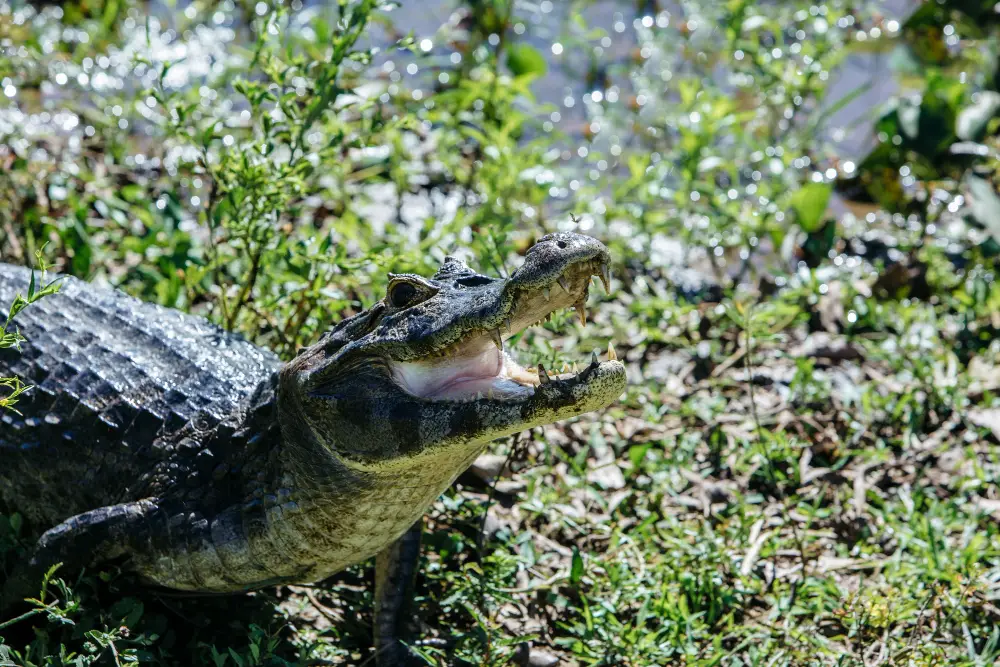
Florida has approximately 1.3 million alligators across all 67 counties. They live in essentially every body of fresh water in the state, including retention ponds in residential neighborhoods, golf course water hazards, creeks parallel to walking paths, lakes in state parks, and natural waterways throughout Jacksonville.
For dog owners, this is not a theoretical concern. Reported incidents of alligator attacks on dogs are far more common than attacks on humans, though precise numbers are not separately tracked by the FWC. The 2024 incident at West Orange Trail in Winter Garden (an alligator killed a dog that ran into a pond chasing ducks) is one of many similar cases reported in Florida each year.
This is the working guide to alligator awareness for Jacksonville dog owners.
The Reality: Jacksonville Has More Water Hazards Than You Think
Common places alligators are present in Jacksonville:
- Retention ponds in apartment complexes and HOA-managed neighborhoods
- Stormwater management ponds along major roads
- Golf course water hazards (TPC Sawgrass area, many others)
- Riverside paths along the St. Johns River and tributaries
- Creeks throughout Mandarin, Fleming Island, and Ponte Vedra
- Lakes within state parks (Hanna Park, Julington-Durbin Preserve)
- Backyard ponds in older established neighborhoods
- Drainage ditches in some areas
A useful rule: if there is fresh or brackish water, assume an alligator could be present, even if you have not seen one. They are excellent at remaining unseen.
When Alligators Are Most Active
Alligator activity peaks May through October but they are present year-round. Peak danger windows:
- Dawn and dusk (general high activity)
- Warm months (mating season, increased movement)
- After heavy rains (flooding can expand their range)
- Spring mating season (April-June) – more aggressive males moving around
In cooler months they are less active but not absent. They simply move and hunt less. A 50-degree morning is not a safe-from-alligators morning.
Why Pets Are at Higher Risk Than People
A 50-pound dog is roughly the size of an alligator’s natural prey. Smaller dogs are more vulnerable still.
The FWC has been clear: pets “often resemble alligators’ natural prey.” Beyond size, dog behaviors near water increase risk:
- Splashing or running at the water edge
- Drinking from a pond or creek
- Wading or swimming
- Chasing ducks, fish, or other animals into the water
- Walking close to the bank
Each of these signals “prey” to an alligator that may be just under the surface, unseen.
The 5-Foot Rule (Water Edges)
The single most important rule: keep your dog at least 5 feet from any water edge, year-round.
This applies to:
- Walks past retention ponds in residential neighborhoods
- Golf course water hazards if you walk a course
- Trails next to creeks or lakes
- Even small drainage ditches that might temporarily hold standing water
Five feet is the minimum. Further is better. Use a short leash (4-6 feet max) when walking near any water, and walk your dog on the side of the path away from water.
Specific Higher-Risk Locations in Jacksonville
These locations have documented alligator activity and warrant extra caution:
- Trails inside Hanna Park (signs are posted, but follow them strictly)
- Julington-Durbin Preserve waterways
- Most stormwater ponds in master-planned communities (Nocatee, Bartram Springs, etc.)
- Black Creek (Fleming Island/Orange Park area)
- Goodby’s Creek (Mandarin)
- TPC Sawgrass and adjacent areas
- Johns River banks at any access point
- Westside lakes including those in the Cecil Field area
This list is not exhaustive. Alligators are not limited to these locations. Assume any fresh water in Florida has the potential to host an alligator.
Dog Behaviors That Attract Alligators
Beyond proximity, certain dog behaviors increase risk:
- Splashing at the water edge
- Barking at the water
- Swimming
- Drinking from the water
- Running along the bank
Train your dog away from these behaviors at any water in Florida. Even a small drainage feature is not a safe drinking source.
What to Do If You Encounter an Alligator on a Walk
If the alligator is in the water and not approaching:
- Stay calm
- Slowly back away, maintaining at least 10 feet of distance
- Do not run in a way that triggers a chase response
- Keep your dog close and on a short leash
- Take a different route
If the alligator is on land (basking on a bank or sidewalk):
- Same as above but with even more distance – 30 feet minimum
- Alligators on land can move surprisingly fast for short distances
- Never approach to take a photo
- Note the location and call the FWC if it appears nuisance-sized (4+ feet)
If an alligator is approaching:
- Make yourself big and noisy
- Wave arms, yell
- Move away in a different direction than the alligator’s approach
- Get your dog to safety first if possible
What to Do If an Alligator Attacks Your Dog
This is the worst-case scenario. There is no perfect protocol. Reported responses include:
- Hitting the alligator’s eyes or nose to attempt to release the bite
- Yelling and waving to startle it
Honest assessment: physical intervention with an alligator is dangerous to you and may or may not succeed. The far better strategy is prevention through the 5-foot rule.
If your dog is injured by an alligator:
- Get to the ER vet immediately
- Even if injuries seem minor, alligator bites carry high infection risk requiring antibiotics
- Cleaning by the vet rather than at home is generally better
Reporting Nuisance Alligators
The FWC’s Statewide Nuisance Alligator Program (SNAP) addresses alligator situations that pose threats.
FWC Nuisance Alligator Hotline: 866-FWC-GATOR (866-392-4286)
The general criteria for “nuisance” is an alligator at least 4 feet in length showing aggressive behavior or approaching people or property. Behavior examples that meet the threshold:
- Alligator approaching you when you are outside near the pond
- Alligator in your pool, garage, or other inappropriate location
- Alligator that has shown aggression toward people or pets
- Aggressive 7+ foot alligator in a residential area
Behavior that generally does NOT meet the threshold:
- Alligator laying on a bank (they do not live exclusively in water)
- Alligator seen briefly at a distance
- Smaller alligators (under 4 feet) in natural water bodies
For broader wildlife emergencies, the FWC Wildlife Alert Hotline is 888-404-3922 (888-404-FWCC).
Sitter and Walker Awareness
If you use a professional dog walker or pet sitter in Jacksonville, ask about their alligator awareness training. A good Florida pet sitter:
- Maintains the 5-foot rule on every water-adjacent walk
- Knows which routes in your neighborhood have water exposure
- Has the FWC hotline saved in their phone
- Knows alligator behavior basics
- Carries a short backup leash for water-adjacent walks if your dog tends to pull
Our dog walking services and in-home pet care include this kind of local awareness as standard practice.
Frequently Asked Questions
Are alligator attacks on dogs really common in Jacksonville?
“Common” depends on definition. Compared to other states, yes – meaningfully more common. Compared to overall daily dog walking activity, no – most dogs go their whole lives without an incident. The risk is real but avoidable with the 5-foot rule.
My yard has a small pond. Can I have it tested for alligators?
The FWC will respond to specific reports but does not routinely survey private water bodies. If you suspect an alligator in a backyard pond, assume yes until proven otherwise. Restrict pet access to the area.
Can I let my dog swim in a Florida lake or pond?
Strong recommendation: no. The risk is real and unpredictable. There are designated swimming areas (with shark/gator monitoring in some places) that are lower risk, but private and natural freshwater bodies in Florida are not safe for dogs to swim in.
What about saltwater? Are there gators in the ocean?
Alligators are freshwater animals. They do occasionally appear in brackish water near coastal estuaries but not in the open ocean. Saltwater beaches present different risks (jellyfish, rip currents, saltwater toxicity) covered in our saltwater and beach swimming risks guide.
What if there is an alligator in my apartment complex retention pond?
Report to your management company so they can post signage. If it appears to meet nuisance criteria (4+ feet, aggressive behavior), call the FWC at 866-392-4286.
Are alligators most dangerous at night?
Most active dawn and dusk, but they hunt opportunistically throughout 24 hours. Dawn and dusk walks past water bodies have elevated risk; midday walks are lower risk but not zero.
A Manageable Hazard If You Plan For It
The 1.3 million alligators in Florida are a fact of life, not a daily emergency. Pet owners who maintain the 5-foot rule near water and stay alert at dawn and dusk almost never have an incident. The risk is concentrated in the small percentage of moments when those rules are forgotten.
Save the FWC hotline number in your phone now: 866-392-4286. Use it.
If you want a Jacksonville pet sitter who understands this risk as part of daily practice, our dog walking services, in-home pet care, and professional pet sitting services treat alligator awareness as standard.