You come home to a shredded couch cushion, a scratched door, and a neighbor’s note about the barking. Your dog meets you like nothing happened. This is the loop a lot of Jacksonville dog owners live in, and it wears you down. The chewing, the pacing, the accidents by the door. It is not spite, and it is not a training gap you failed at. It is dog separation anxiety, and the fix has less to do with discipline than with the hours your dog spends alone.
Let me walk through what is going on in your dog’s head, and how a visit in the middle of the day breaks the pattern.
What Separation Anxiety Looks Like
Separation anxiety is panic, not misbehavior. When you leave, the dog’s stress climbs and keeps climbing with no way to burn it off. The dog is not plotting revenge on the door frame. It is trying to cope with a feeling it cannot control.
The Signs Owners Miss
Some signs are loud. Chewed baseboards, torn cushions, claw marks on the door, puddles from a house-trained dog. Others are quiet and easy to miss. Pacing the same path. Drooling in the crate. Barking that starts the second you pull out of the driveway and runs for an hour. Refusing food while you are gone, then eating the moment you walk in. If any of that sounds like your dog, the hours alone are the thing to look at.
Why It Builds Over the Day
A dog’s stress does not hold flat while you are at work. It spikes hardest in the first thirty to sixty minutes after you leave, then simmers. In a long workday, that means hours of a dog sitting in a state it cannot shake. The longer the stretch, the more the dog reaches for an outlet, and chewing, digging, and barking are the outlets it has.
How a Midday Visit Changes the Math
Here is the part that gets overlooked. You do not need a training overhaul to see the destructive behavior drop. You need to break the alone stretch into pieces the dog can handle.
The Clock Gets Cut in Half
A dog left from eight to six faces ten hours by itself. Slide one visit in around noon and that ten-hour block turns into two five-hour blocks. For an anxious dog, that reset matters more than the total. The dog learns that the door opens partway through the day, that company comes, that the alone time has an end it can count on. That single break does more for a lot of dogs than any toy or chew left out to keep them busy, because the problem was never boredom. It was the length of the stretch.
Movement Burns Off the Stress
An anxious dog is a wound-up dog. A walk in the middle of the day drains the charge that feeds the pacing and chewing. The dog comes back from the loop tired instead of buzzing, and a tired dog rests instead of tearing into the couch. The rest of the afternoon looks different because the dog spent its energy on the sidewalk, not the sofa.
A Routine the Dog Can Trust
Dogs settle on patterns. When the midday visit happens at the same time each day, the dog stops watching the clock in a panic and starts waiting for a thing it knows is coming. That shift, from dread to expectation, is where the destructive behavior starts to fade. The dog is calmer because the day makes sense to it now.
What a Visit for an Anxious Dog Involves
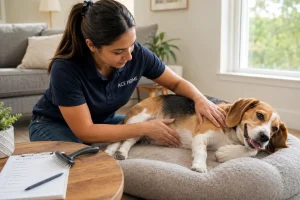
A visit built for separation anxiety is more than a bathroom break. The sitter comes in calm, without the big greeting that spikes the dog back up. There is a walk to burn energy. There is water, a check that food from the morning went down, and some quiet company so the dog logs the visit as a settled part of the day. For dogs that spiral hard, a couple of shorter visits can beat one long one, since it shrinks every alone stretch instead of just the middle.
The sitter also watches for the small stuff. A dog whose anxiety is climbing shows it in the body before it shows it in the house. Someone paying attention catches the pattern and can flag it early, so you and your vet can step in before it gets worse.
What a Visit Will Not Fix on Its Own
A midday visit is a large piece, not the whole answer. Bad separation anxiety sometimes needs training work with a behaviorist, and in some cases a vet brings medication into the plan for a while. The visits and the training pull in the same direction. The dog that gets a break in the day has an easier time with the training, because it is not starting every session already frayed.
If your dog is hurting itself trying to escape, breaking teeth on a crate or tearing nails on a door, that is past the point of visits alone. Loop in your vet. That level of panic needs a fuller plan.
Where to Start
Watch your dog for a week. Note when the barking starts, what gets chewed, if food gets touched. Point a camera at the room if you can, since the footage tells you more than the aftermath does. Take that to your vet so you know what you are dealing with.
Then look hard at the alone stretch. If your dog faces eight or ten hours by itself most days, a daily visit is the change that moves the needle first. It is the difference between a dog white-knuckling the whole day and a dog that knows relief is coming at noon. The couch survives, the neighbors stop leaving notes, and your dog spends far less of its day in a state no animal should have to sit in.