If your dog is showing signs of heatstroke right now, scroll to the protocol section. If you are reading this on a calm day to prepare, read the whole thing. Either way, the most important thing to remember: cool first, transport second.
Heatstroke kills dogs in Florida every summer, and most cases are preventable. The cases that reach the ER vet have often been delayed because owners did not know to cool the dog before transport, or were afraid of doing it wrong.
Symptoms: Mild, Moderate, Severe
Heatstroke is a spectrum. The earlier you intervene, the better the outcome.
Mild (heat exhaustion):
- Heavy panting
- Excessive drooling
- Restlessness, looking for cooler ground or shade
- Slight redness of gums
Moderate (early heatstroke):
- Very fast, labored panting
- Bright red gums and tongue
- Increased heart rate
- Vomiting or diarrhea
- Weakness or unsteadiness
- Confusion or disorientation
Severe (true emergency):
- Body temperature above 105 degrees Fahrenheit
- Dark red or purple gums
- Glassy eyes
- Collapse
- Seizures
- Loss of consciousness
- Pinpoint blood spots on gums or skin (clotting failure)
Mild signs warrant immediate cooling and watchful monitoring. Moderate signs warrant cooling AND vet contact. Severe signs warrant immediate cooling AND transport to the ER vet simultaneously (one person cools, another drives or calls).
Normal dog body temperature is roughly 101.5 degrees Fahrenheit, plus or minus 1 degree. Above 105 degrees is a true emergency.
The First 5 Minutes: Step-by-Step Protocol
Step 1: Stop activity immediately.
Get your dog out of the sun and out of the heat source. Indoors with AC, into shade with a breeze, into your car with AC on full – whichever is closest.
Step 2: Begin active cooling.
This is where most owners hesitate. Do not. Active cooling is the single most important thing you can do.
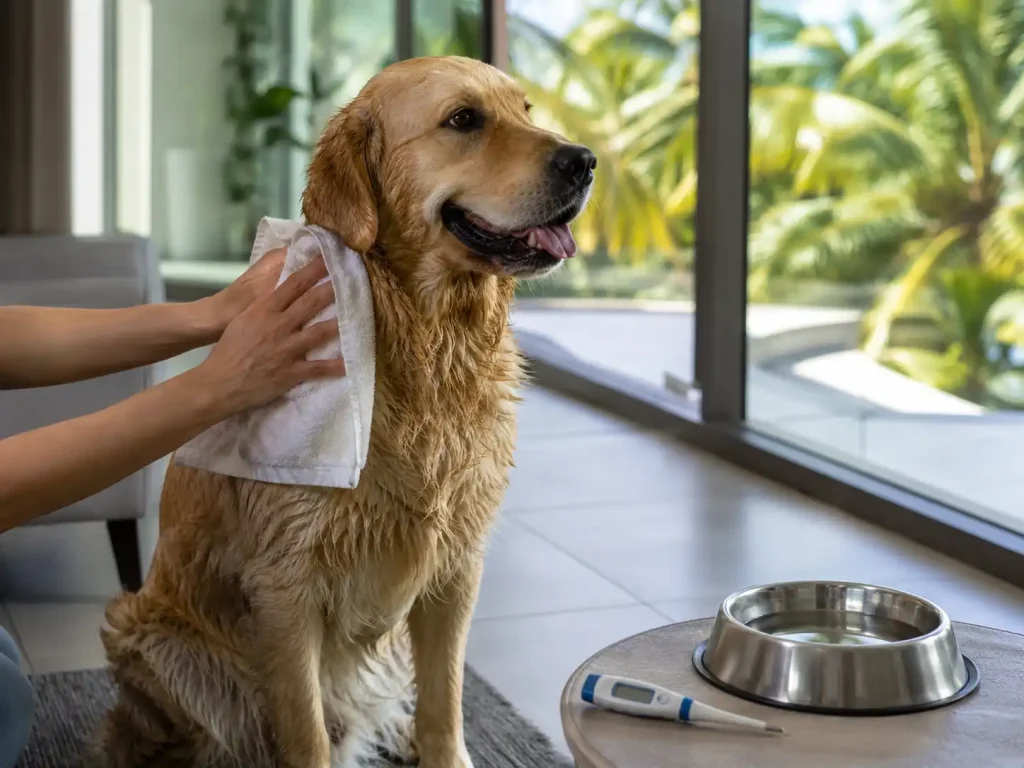
For a healthy young dog: Pour cool water (NOT ice water) over your dog’s entire body. Bath, shower, hose, lake, whatever you have. Focus on the head, neck, armpits, groin, and paws. Continuous cool water immersion is ideal if available.
For a senior, brachycephalic, sick, or very young dog: Use the evaporative method instead. Pour cool water over the dog and direct a fan or strong breeze across them. The evaporation lowers body temperature steadily without the shock risk that immersion can carry in vulnerable dogs.
Step 3: Take their temperature if possible.
A rectal thermometer is ideal. If you have one in your pet first aid kit, use it. Goal: cool to 103 degrees Fahrenheit, then stop active cooling.
If you have no thermometer, use a 10-minute time limit on active cooling, then assess.
Step 4: Offer small amounts of water.
Do not force. Do not flood. Small sips. Some dogs will not drink during heatstroke; do not push it.
Step 5: Call the ER vet while cooling.
Phone them while continuing to cool the dog. Tell them what is happening and that you are on the way. They can prep IV fluids and have a team ready when you arrive.
Cooling Protocol: Cool Water, Not Ice Water
This is where the conflicting advice causes problems. Here is the current state of the evidence:
The 2016 American College of Veterinary Emergency and Critical Care (ACVECC) recommendation supports cool water immersion as the most effective cooling method for healthy young dogs. The UK Royal Veterinary College’s VetCompass research backs this up – dogs who were actively cooled before vet arrival had dramatically better outcomes than those who were not.
Why not ice water specifically?
- Ice water causes peripheral vasoconstriction (skin blood vessels narrow)
- This traps heat in the core
- For older or compromised dogs, it can cause shock
The working translation for owners:
- Tap water from a hose is generally ideal in Florida summer (it is already warmer than ice water but much cooler than the dog)
- Pool water works
- Lake or pond water works in a true emergency (rinse the dog after with clean water if available)
- Bathtub water (cool, not icy) works
- Even fountain water in a parking lot is better than nothing
The clinical priority is rapid temperature reduction. Cool-not-cold water is the safer middle ground that most situations support.
Do NOT:
- Cover your dog with wet towels – this insulates and traps heat
- Use ice packs unless that is genuinely all you have available
- Pour rubbing alcohol on paws (an old folk remedy – it is not effective and can cause harm)
When to Rush to ER vs. Stabilize First
The “cool first, transport second” principle does NOT mean delay vet care. It means cool while you arrange transport, then transport with cooling continuing en route if possible.
Cool first, then go to ER even after recovery if:
- Body temperature was above 104 degrees at any point
- Dog had vomiting or diarrhea
- Dog showed any neurological symptoms (stumbling, confusion, seizure)
- Dog is a brachycephalic breed, senior, very young, or has known health conditions
Heatstroke causes internal damage (kidneys, liver, GI tract, clotting system) that can manifest hours later. A dog that “seems fine” after cooling can deteriorate at midnight. The ER vet visit is to assess and treat that internal damage, not just to address the immediate heat episode.
What to Tell the ER Vet on the Phone
When you call:
- What you suspect (heatstroke)
- What activity preceded it
- How long since it started
- Current dog temperature if you took it
- Cooling measures you have taken
- Your dog’s age, breed, weight, and any health conditions
This lets them prep specifically for your dog and your case.
Florida Humidity Multiplier
Standard heat indices underestimate the danger to dogs in Florida.
Why: Dogs cool primarily through evaporation from panting. Florida humidity reduces evaporative cooling efficiency. The same 90-degree day in Phoenix and Jacksonville is more dangerous to a dog in Jacksonville because panting works less well.
Practical rule for Florida:
- Air temperature above 85 with high humidity = limit outdoor activity
- Air temperature above 90 = morning and evening only
- Air temperature above 95 = brief outdoor breaks only, indoor activity
- Heat index above 100 = significant risk even briefly outdoors
A pavement check is mandatory in summer. If you cannot comfortably hold the back of your hand against the sidewalk for 5 seconds, your dog cannot walk on it.
Brachycephalic Breed Specifics
Flat-faced dogs (Frenchies, Bulldogs, Pugs, Boxers, Boston Terriers) have anatomically restricted airways that reduce their ability to pant effectively. They overheat much faster than other breeds at the same temperature.
For these breeds:
- The danger zone starts at lower temperatures
- Symptoms can escalate from “panting heavily” to “collapse” within minutes
- ER visits should be at a lower threshold of suspicion
- Many owners discuss BOAS surgery with their vet to widen airways permanently
Full coverage in our brachycephalic dogs in Florida heat guide.
Recovery and Long-Term Effects
Even after a successful ER visit, heatstroke can have ongoing effects:
- Kidney function may be impaired – vet may monitor with blood work for several weeks
- GI tract may need time to heal
- Some dogs become more heat-sensitive after a heatstroke episode, requiring lifelong extra precautions
- Severe cases can have neurological effects that take months to resolve, if they fully do
The takeaway: prevent first, intervene fast if it happens, follow vet guidance closely afterward.
Prevention Quick Reference
The protocol above is what to do when heatstroke happens. The protocol to prevent it is:
- Walks in cool windows only (before 9 AM or after 7 PM May-September)
- Pavement test before any walk
- Water available constantly
- Never left in cars
- AC running indoors during dangerous days
- Brachycephalic breeds with extra-low thresholds
See our Jacksonville summer heat safety guide for the full prevention plan.
Frequently Asked Questions
How fast can heatstroke kill a dog?
Severe heatstroke can become fatal within an hour without intervention. Cool water immersion within 5-10 minutes of symptom onset dramatically improves outcomes.
Should I induce vomiting in a heatstroke dog?
No. Focus on cooling. Do not give anything by mouth except small sips of water if the dog is alert and accepting it.
Can heatstroke happen indoors?
Yes. AC failure, hot rooms with no airflow, sun-facing rooms in afternoon, and prolonged exercise in stuffy indoor spaces can cause heatstroke even without direct sun. It is less common but real.
What temperature does a dog have to reach for heatstroke?
The threshold is around 105 degrees Fahrenheit for serious heatstroke, but damage can begin at 104 degrees. Normal canine body temperature is 101.5 plus or minus 1 degree.
My dog was outside in the heat and seems hot but is acting normal. What should I do?
Bring them indoors to cool down, offer water, take their temperature if you can. If they are alert, eating, drinking normally, and the temperature is below 104, monitor closely for the next several hours. If anything escalates, head to the ER vet.
Can cats get heatstroke?
Yes. Less commonly than dogs (cats are generally more heat-cautious by nature), but possible. Brachycephalic cats (Persians, Himalayans, Exotic Shorthairs) are at elevated risk. Same first aid principles apply with even more attention to gentle cooling.
Print This and Put It on Your Fridge
The protocol is simple. The hard part is acting fast when you see it. Many owners freeze the first time. The fastest way to overcome that is to have the steps mentally rehearsed.
Cool water. Wet down. Fan or breeze. Call ER. Drive while continuing to cool.
That sequence has saved many Florida dogs. Practice it in your head a few times this summer.
If you live in Mandarin, Southside, Fleming Island, Ponte Vedra, or Jacksonville Beach and want a sitter trained in this protocol who treats it as standard practice, reach out about our in-home pet care and dog walking services.