The most common question we get from new Jacksonville puppy owners isn’t about food or vaccines it’s about daycare. Specifically, when. Owners are usually working from home with a puppy underfoot, exhausted, and looking at every dog daycare website in a 15-mile radius wondering if their 10-week-old is “old enough.”
Short answer: not yet. And the right answer is more nuanced than wait until they’re four months old.
For the broader puppy roadmap, start with our complete puppy owner guide. This post is specifically about the daycare timing decision.
The Short Answer: Why Age Alone Isn’t Enough
Most Jacksonville daycares set a minimum age of 16 weeks. That’s the floor, not the goal. A 16-week-old puppy who is anxious, undersocialized, or vaccine-incomplete will have a bad first day no matter what the website allows.
The real readiness check has three pillars:
- Vaccination status Non-negotiable, set by the daycare and your vet
- Behavioral readiness Often skipped, but more important than age
- Daycare format match Some daycare environments suit puppies; others don’t
Let’s go through each.
Vaccination Requirements at Jacksonville Daycares
Most reputable Jacksonville daycares require proof of the following before admittance:
DHPP Series Completion
The DHPP (distemper, hepatitis, parvovirus, parainfluenza) series usually runs: – First shot: 6-8 weeks – Second shot: 10-12 weeks – Third shot: 14-16 weeks
Your puppy reaches full immunity roughly 1-2 weeks after the third shot. So even if the daycare allows entry at 16 weeks, biological reality says wait until 17-18 weeks at minimum after that third DHPP.
Bordetella (Kennel Cough)
Almost every Jacksonville daycare requires Bordetella, ideally given at least 7 days before the first day. The intranasal version takes effect faster than the injectable. Ask your vet which they’re giving.
Rabies Timing
The rabies vaccine is given between 12 and 16 weeks. It’s legally required for daycare. Make sure your vet records show the date clearly many daycares now require a vet-stamped form.
Why Your Puppy Can’t Start at 12 Weeks
Owners sometimes call frustrated: “But my puppy is so social! Why can’t they start now?” The answer is parvovirus. A 12-week-old puppy in a daycare environment even a clean one has roughly 30-40% protection from parvo. A 17-week-old, fully boostered puppy has 95%+ protection. Parvo is a high-mortality, expensive disease. The math isn’t close.
Behavioral Readiness Signs
A puppy can be the right age and fully vaccinated but still not ready for daycare. Look for these readiness signs:
- Confidence around unknown dogs. Your puppy approaches new (vaccinated, known-friendly) dogs with curiosity, not hiding or hyperventilating.
- Recovery from overstimulation. After 20 minutes of play, your puppy can settle down within 5-10 minutes if you remove them from the action.
- Basic crate or pen tolerance. Daycares use crates for naps, breaks, and separation. A puppy who panics in a crate will have an awful day.
- Eating in unfamiliar places. A puppy that won’t eat or drink in a new environment won’t last a full day.
Red flags that suggest waiting: – Tucked tail, frozen body, or escape attempts around new dogs – Inability to settle (constant pacing, panting in calm environments) – Severe separation distress from you – Recent illness, surgery, or trauma
Recommended Age Brackets
16-18 Weeks: Trial Half-Days Only
If your puppy is fully vaccinated and confident, this is the earliest reasonable window. Ask the daycare for a 2-3 hour trial. Pick a quieter midweek morning. Don’t book a full day yet.
5-6 Months: Full-Day Participation
Most puppies are ready for full days at this point if they passed the half-day trial. Expect them to come home exhausted for the first month — that’s normal.
6-12 Months: Structured Play Groups
Look for daycares that group dogs by size, energy, and play style. A 9-month-old Goldendoodle thrown in with a pack of small senior dogs is bored; the reverse is dangerous.
Preparing for the First Day
Don’t just show up. We cover this in depth in our how to prepare your dog for their first day at daycare guide, but for puppies specifically:
- Visit the facility once before, without your puppy, to see how it’s run during the day
- Bring all vaccine records in advance, not on day one
- Pack a familiar blanket and one favorite chew (label them)
- Feed lightly that morning to reduce GI upset
- Plan a quiet evening at home after pickup — they’ll be wrecked
Our what a full day of doggy daycare looks like post walks through a typical day so your expectations are calibrated.
In-Home Daycare vs. Facility Daycare for Puppies
Not all daycare is the same. Two main formats serve Jacksonville:
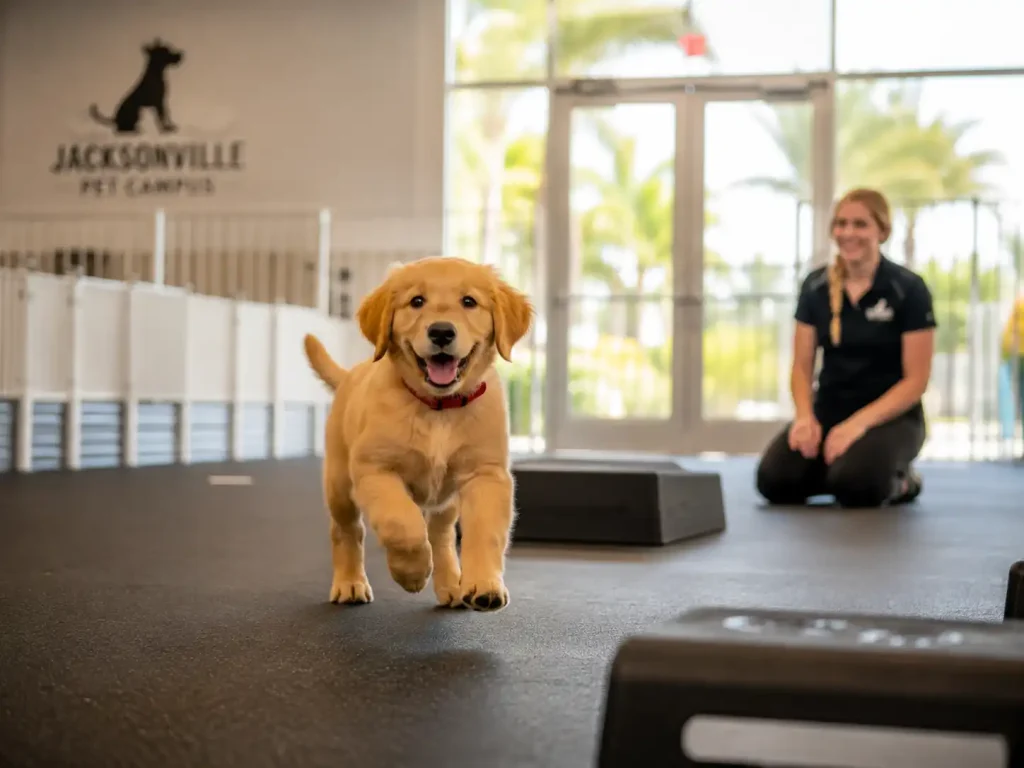
Facility daycare A commercial location with multiple staff, dedicated play yards, and 15-40 dogs. Good for energetic puppies who thrive on social chaos and need structured exercise. Less good for sensitive puppies or breeds that overheat easily.
In-home daycare (or extended sitter visits) A pet sitter caring for a small number of dogs in a residential setting, or multiple drop-in visits across the day. Better for puppies who do best in small groups, brachycephalic breeds who can’t handle prolonged group play in Florida heat, or owners who want closer supervision.
Our in-home pet care service is often the better fit for the youngest end of the puppy spectrum — 16-20 weeks — where a quieter environment gives the puppy a softer landing into structured care. Many Jacksonville families transition from in-home daycare to facility daycare around 6 months.
For broader cost context, see our affordable Jacksonville daycare guide and is dog daycare worth it post.
Frequently Asked Questions
Can my puppy go to daycare at 12 weeks?
Some daycares allow it; most reputable ones don’t. Even if a facility says yes, your puppy doesn’t have full vaccine protection yet, and parvo risk is real. Wait until 1-2 weeks after the third DHPP, typically 17-18 weeks.
Do I need to socialize my puppy before daycare?
Yes. Daycare is not where you socialize a puppy it’s where you graduate them to once they’re already confident with dogs and people. See our puppy socialization timeline for the foundational work that happens first.
How often should my puppy go to daycare?
For most puppies, 2-3 days a week is plenty. Daily daycare is exhausting for young dogs and can lead to overstimulation, reactivity, and burnout. A mix of daycare days, walks, and quiet days is healthier.
My puppy got kennel cough after starting daycare did I do something wrong?
Probably not. Even with vaccination, kennel cough spreads in any group setting. It’s usually mild and self-limiting. Stay home until cleared by your vet, and rest assured this happens to nearly every daycare puppy at some point.
Is in-home pet care a good alternative to daycare?
For young puppies (16-20 weeks), often yes. The quieter pace, individualized attention, and structured potty schedule of in-home pet sitting suits the youngest end of the spectrum. Many families combine both as their puppy matures.
Get the Timing Right
Daycare done at the right age, after the right preparation, is one of the best investments you can make in your puppy’s first year. Done too early or in the wrong format, it backfires.
If you’re in the Mandarin, Southside, Fleming Island, Ponte Vedra, or Jacksonville Beach areas and you’d like to talk through whether your puppy is ready or whether in-home care is the better first step get in touch.