There are hundreds of crate training guides on the internet, almost all of which assume you live somewhere with four seasons and forced-air heating. You live in Jacksonville. Your crate has to deal with afternoon temperatures that hit 95 degrees, AC zones that vary by 8 degrees between rooms, hurricane evacuations, and a year-round mosquito situation that affects where you can leave a door open.
Here’s the Florida-adapted version of crate training your new puppy.
For the broader new puppy roadmap, see our complete puppy owner guide.
Why Crate Training Matters for Jacksonville Pet Parents
Most owners crate train because the internet told them to. Florida owners have specific reasons that the average guide overlooks:
- Hurricane evacuation. When you have 24 hours to leave Jacksonville with your pet, a crate-trained dog is the difference between an evacuation that works and one that goes badly. See our hurricane pet safety guide for context.
- Sitter visits. When a pet sitter visits and your puppy needs a safe spot during, say, a contractor visit, the crate is invaluable.
- Vet stays and recovery. Every puppy will need at least a spay/neuter recovery period in a confined space. A crate-trained puppy handles this with calm.
- Florida road trips, vet transport, eventual flights all easier with crate comfort.
- Daycare graduation. Most Jacksonville daycares use crates for nap times and separation. A crate-stressed puppy struggles.
If you skip crate training, you don’t avoid the crate you just discover you need it later, in a panic, when your puppy isn’t ready.
Choosing a Crate
Two main choices, each with Florida-specific implications:
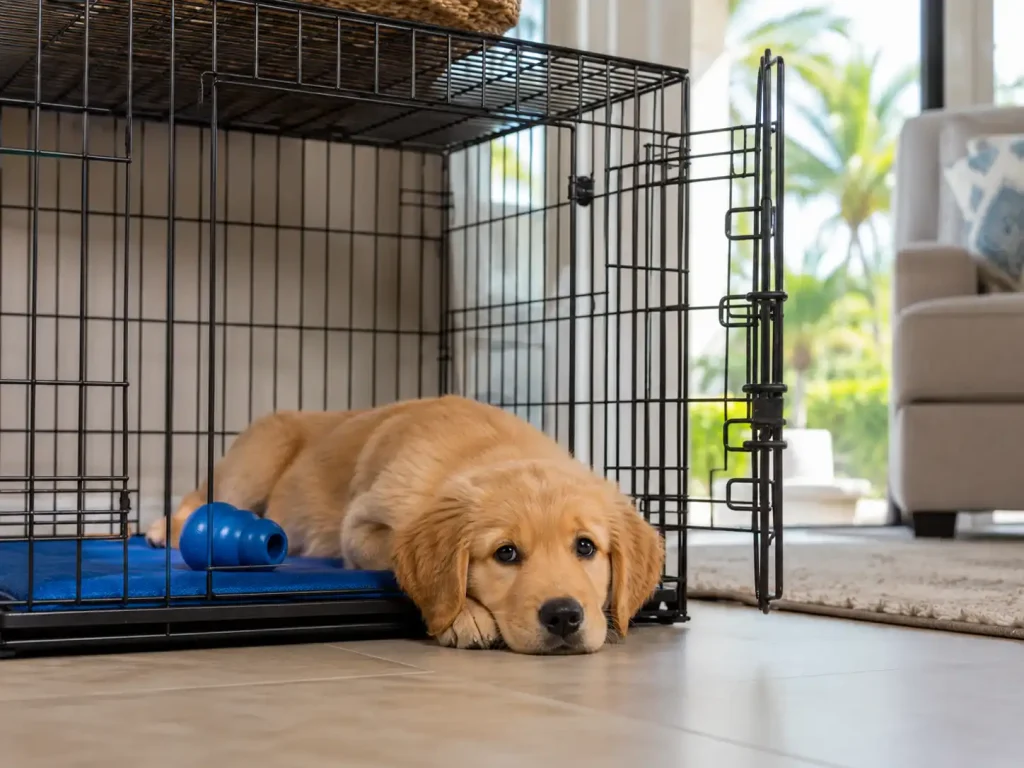
Wire crates breathe better in humidity. They allow airflow, easy cleaning, and visibility (puppies feel less isolated). Downside: harder to keep cozy in colder months, easier for a determined chewer to bend.
Plastic (airline-style) crates are quieter, more den-like, and better for travel. Downside: they trap heat, get musty in humid air without ventilation, and a Florida summer can turn a closed plastic crate into a dangerous environment.
For most Jacksonville puppies, wire crate with a fitted cover is the right choice. You get airflow when you want it (cover off) and den feeling when you want it (cover on).
Sizing: get an adult-size crate with a divider you can move as the puppy grows. The crate should be big enough for the adult dog to stand, turn around, and lie down comfortably no bigger. Too much space and puppies will pee in one corner and sleep in another.
Placement in a Florida Home
This is where Florida departs from the generic advice. Where you put the crate matters more than what crate you buy.
AC-Zone Considerations
Most Florida homes have rooms that vary widely in temperature. A west-facing room in afternoon sun can be 78°F while a north-facing bedroom on the same AC system is 72°F. Place the crate in a room that stays consistently between 70-76°F. Check it at the hottest part of the day 3-5pm before committing.
Away From Direct Afternoon Sun
A crate near a west-facing window without UV-blocking shades will heat dangerously between 2-6pm in summer. Even with AC on, direct sun adds significant heat.
Where NOT to Put It
- Heat extremes, isolation, exhaust fumes. Don’t crate a puppy in a garage, even briefly, in Florida summers.
- Laundry rooms. The dryer raises room temperature significantly, and the noise startles new puppies.
- Lanais and screened porches. Florida lanais reach dangerous temperatures by mid-morning in summer. Never use as a long-term crate location.
- Foyers next to front doors. Constant traffic and Florida heat seeping in.
Best Locations
Generally: – Living room corner, where the family is present during the day – Bedroom corner near where you sleep, for overnight – A guest room or office that stays well-AC’d and quieter
Many owners use two crates one for daytime in the family area, one for overnight in the bedroom. This isn’t wasteful; it’s practical.
The 30-Day Crate Training Timeline
Days 1-3: Introduction
Set up the crate with the door open. Place treats and a soft toy inside. Don’t close the door. Let your puppy explore. Feed meals at the crate entrance, then over the next day, inside the open crate.
Days 4-7: Closed-Door Short Stints
After your puppy is eating happily inside, close the door for 1-2 minutes while you sit nearby. Open before any whining starts. Repeat 5-6 times a day, gradually increasing to 5 minutes.
Days 8-14: Building Duration
Extend to 10-15 minutes with you in the room. Then start leaving the room briefly — 30 seconds first, then 2 minutes, then 5. Always return calmly. Don’t make a fuss arriving or leaving.
Days 15-21: Real Absences
Practice 30-45 minute absences (running an errand) by the end of week 3. Your puppy should settle within a few minutes after you leave.
Days 22-30: Workday Conditioning
Extend crate time toward your real schedule needs. Most 12-week-old puppies should not exceed 3 hours in the crate during the day. Build up gradually as they age. For longer workdays, mid-day sitter visits bridge the gap.
Common Mistakes
- Using the crate as punishment. Wrecks the association. The crate must always be a positive place.
- Letting the puppy out while crying. Teaches them that crying gets results. Wait for a calm moment, then release.
- Leaving too long, too soon. A 10-week-old puppy in the crate for 6 hours will have an accident and lose crate trust. Match crate time to hold time.
- Skipping enrichment. A frozen Kong, a long-lasting chew, or a snuffle mat in the crate makes the time meaningful, not just empty.
- Crating a puppy alone overnight in another room from day one. Most puppies do better with crate in your bedroom for the first few weeks, then graduated to elsewhere.
Crate Training for Future Sitter Visits and Travel
The crate-trained puppy is much easier for a pet sitter to manage during visits naps, time-outs from overstimulation, contractor visits, and your overnight travel. When booking overnight pet care, share your puppy’s crate routine in detail so the sitter can maintain consistency. Our what to tell your pet sitter post covers exactly what to communicate.
When NOT to Crate
The crate isn’t the right answer in every situation:
- Severe heat warnings. If your AC is out and the home temperature is above 82°F, do not crate. Use a small AC’d room or supervise directly.
- Severe separation anxiety. A puppy with true panic-level separation anxiety can hurt themselves trying to escape a crate. Address the anxiety first.
- Illness or post-surgery. Some recoveries require movement restriction but in a larger pen, not a small crate.
Frequently Asked Questions
How long can I crate my 12-week-old puppy?
Roughly 3 hours maximum during the day, 6-8 hours overnight (assuming a pre-bed potty and no water access in the hour before bed). Each puppy is different; watch for distress signs.
My puppy cries in the crate. What do I do?
If it’s brief (under 10 minutes) and they settle, ignore it. If it’s frantic and prolonged, you’ve moved too fast in the protocol — back up to shorter, easier crate stints and rebuild slowly. Crying that includes urgency or sudden onset can also indicate they need a potty break.
Can I crate train an older dog?
Yes, the protocol just takes longer typically 6-8 weeks rather than 4. For owners adopting adolescents or rescues, crate training is doable but should be even more gradual.
Should I use a crate cover?
Often helpful. A breathable cover (not heavy blackout fabric) gives a den feeling and reduces stimulation, which helps anxious puppies settle. In Florida, use lightweight breathable covers, never heavy blankets that trap heat.
What if my puppy already had a bad crate experience?
It happens especially with rescues. Start over completely. Move the crate to a different location, change the bedding, and proceed slowly through the protocol over weeks rather than days. Pair it with extra positive reinforcement.
Crate Training Pays Off for 15 Years
A four-week investment in crate training during your puppy’s first months pays back for the entire life of the dog. Hurricane evacuations, vet stays, travel, sitter visits, daycare graduation they all become easier, calmer, and safer.
If you’re in the Mandarin, Southside, Fleming Island, Ponte Vedra, or Jacksonville Beach areas and want help establishing or maintaining your puppy’s crate routine during your travel, our in-home pet care service and overnight pet sitting are designed for exactly this. Reach out anytime.