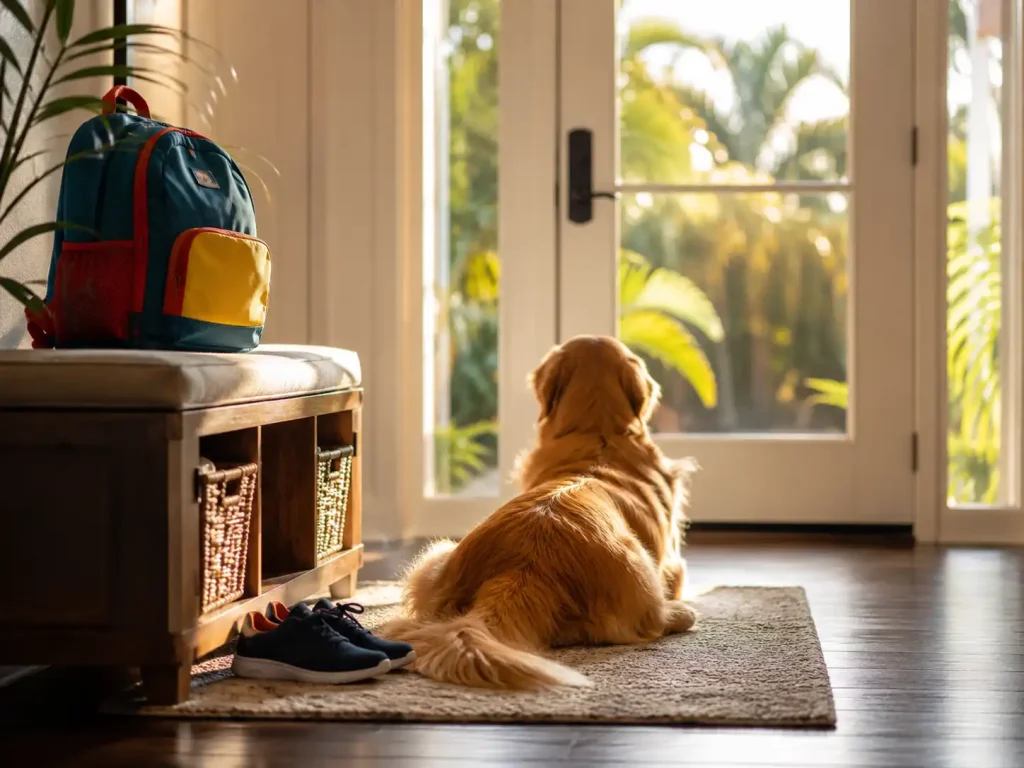
For three months your dog has been part of a busy household: kids home, food sounds in the kitchen, doors opening, voices, snacks dropped on the floor, midday walks, afternoon naps with someone next to them. Then suddenly, on a Monday in August, the house is silent at 7:45 AM. They wait at the door. No one comes home for hours.
Most owners do not realize how hard the back-to-school shift hits dogs until they see the symptoms: destructive behavior, excessive barking, accidents in previously reliable dogs, weight loss, or appetite changes. The dog who seemed fine in June is not fine in late August.
This is a working guide for Jacksonville families with kids and dogs, on how to manage the transition without crisis.
What Changes for Your Dog
The shift looks small from a human standpoint and enormous from a dog standpoint:
- Constant company becomes 6-9 hours alone
- Continuous low-level noise becomes silence
- Multiple food and treat moments become one or two
- Multiple short walks (whoever takes the dog out) becomes a tight morning-evening schedule
- After-school chaos starts an hour earlier or later than what feels natural
For dogs that were already showing mild separation issues, this is when they crystallize into real behavior problems.
Signs Your Dog Is Struggling
Watch for these in the first 2-4 weeks after school starts:
- Destructive behavior during alone hours (chewing, digging at doors, ripping bedding)
- Excessive barking or howling (neighbors will let you know)
- Accidents in previously house-trained dogs
- Loss of appetite or eating much faster than usual
- Excessive licking or scratching
- Greeting behaviors that feel desperate (excessive jumping, frantic excitement)
- Lethargy or withdrawal
- New “shadowing” behavior – following family members constantly when home
If you see several of these, your dog is telling you the new schedule is too much.
The Two-Week Gradual Transition Plan
The cleanest approach starts two weeks before school resumes. Most owners do not do this and just absorb the chaos when it happens. Doing this small amount of preparation pays back significantly.
Week 1: Mirror the School Schedule
Two weeks before school starts:
- Start waking the dog at the new school-day time
- Feed at the school-day breakfast time
- Walk on the new schedule
- Practice the morning departure (everyone leaves the house, even if just to circle the block)
- Keep alone time gradually increasing – 1 hour Monday, 2 hours Tuesday, building up
Week 2: Full Practice Runs
One week before school:
- Run the full schedule three days that week (morning out, return briefly mid-day, normal afternoon home)
- Test mid-day coverage if you will be using a sitter (see below)
- Make sure your dog’s safe-room or alone-space setup is calm and stocked
By the actual first day of school, your dog has already practiced. The shift is smaller.
Mid-Day Coverage Options
For most working Jacksonville families with school-age kids, 9-10 hour absences will start in late August. That is too long for most dogs to handle alone, especially when it is a sudden change.
Option 1: Pet Sitter Mid-Day Visits
A 30-minute mid-day visit from a pet sitter breaks an 8-hour day into two manageable 4-hour stretches. For most dogs, this is the cleanest solution. Visits cover:
- Outside potty break
- Water refresh and brief feeding if scheduled
- Short walk or play
- Brief enrichment (puzzle feeder, fresh chew)
- Calm transition back to alone time
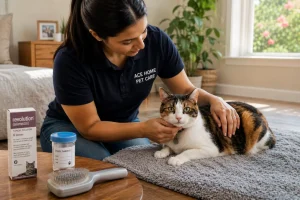
Our professional pet sitting and dog walking services include mid-day visit coverage. For working-family households, this is the most common back-to-school solution.
For Jacksonville pet sitter cost ranges, see our pet sitter cost guide.
Option 2: Dog Daycare
For high-energy dogs who do well with social play, dog daycare 2-3 days a week breaks up the alone time pattern and adds structured exercise.
Considerations:
- Dogs need to be vaccinated and Bordetella-current
- Daycare is exhausting; many dogs need recovery days between
- Costs vary significantly across Jacksonville options
Our dog daycare services include options for school-aged families. For broader daycare evaluation, see our is dog daycare worth it in Jacksonville post.
Option 3: Family or Neighbor Coverage
If you have informal help, formalize it. A retired neighbor who walks your dog mid-day, a college-aged kid home for summer who continues into the fall, or an arrangement with another working family on alternating days – these can work if they are reliable. The key word: reliable.
Option 4: Combined Schedule
Many Jacksonville families use a mix: daycare 2 days a week, sitter visits 2 days, family coverage 1 day. Variety reduces the daily monotony and works for high-energy dogs who would burn out on pure daycare.
Managing After-School Chaos
The other side of back-to-school is the afternoon. School ends, kids come home, the house goes from silent to chaotic. Some dogs love this. Others find it overwhelming.
After-School Zoomies
Many dogs who have been alone all day explode with energy when the family returns. This is normal. Channel it:
- 15-20 minute walk immediately when kids get home (not in afternoon heat – see schedule notes below)
- Structured play (fetch, tug, training) for 10-15 minutes
- Cooldown with a chew while kids do homework
Overstimulation
For sensitive dogs, the sudden energy and noise is stressful. Set up a quiet space (crate or back room) where they can decompress while the kids’ activity is at peak.
Jacksonville Heat Schedule
Back-to-school happens in August, the hottest month in Jacksonville. After-school walks (3-4 PM time frame) often hit the heat danger zone. Adjust:
- After-school: short play in shade, water break, indoor cooldown
- Real walks: 6 PM or later when temperatures drop slightly
- See our Jacksonville summer heat safety for full heat protocols
Long-Term Routine Tips
After the first few weeks, settle into rhythms that work:
- Consistency matters more than perfection – keep meals and walks at predictable times
- Build in human-dog connection time daily (10 minutes of focused attention beats 2 hours of background presence)
- Watch for behavioral drift over the school year – some dogs adjust well in September and start struggling again in November
- Plan for school holidays – schedule disruptions in the other direction also affect dogs
- Spring break, Thanksgiving, and winter break flip the schedule again; our Spring Break pet care guide and holiday booking guide cover these
Frequently Asked Questions
How many hours can my dog be alone during the school day?
Adult, healthy dogs can typically handle 6-8 hours with prep (good morning exercise, bathroom break, mental enrichment). Puppies cannot – their bladder capacity is much lower. See our puppy potty training while at work guide. For most working Jacksonville families with school-age kids, 8-9 hours is on the edge of what dogs handle well alone, and mid-day coverage solves it.
My dog seemed fine the first week, then started having issues. What happened?
Common pattern. The first week, novelty plus residual summer energy carries them. By week 2-3, the cumulative effect of less attention and longer alone time builds up, and behavioral issues emerge. Plan to reassess at week 3.
Should I get my dog a companion to help with back-to-school?
Sometimes works, sometimes makes things worse. Two anxious dogs together is twice the destruction. Two well-adjusted dogs together can keep each other company. Do not get a second dog to solve a behavioral problem – first solve the problem.
Is it cruel to leave my dog alone all day?
Not inherently. Dogs sleep most of the day when alone. The issue is sudden, dramatic schedule changes (going from constant company to constant alone), not the alone time itself. Gradual transitions and mid-day breaks address most of the welfare concerns.
What if my dog hates the sitter at first?
Most dogs warm up over 2-3 visits. If after 4-5 visits your dog is still showing distress, the match may not be right. Try a different sitter or coverage approach. See our introducing your dog to a new pet sitter guide.
What about cats during back-to-school?
Cats generally handle the shift better than dogs, but some cats with strong attachments to kids show withdrawal, decreased appetite, or destructive behavior. Watch for any major change in routine, eating, or litter box habits.
Plan the Transition Now, Not in August
The Jacksonville back-to-school surge for pet sitters and dog walkers starts in early August. Booking ahead means you have continuity of care, not a stranger showing up the first week your dog needs it most.
If your household includes school-age kids and a dog who is about to lose most of their daytime company, our in-home pet care and affordable pet care options include school-year coverage plans. Contact us by mid-July to discuss the fall schedule.