Cat ownership in Florida is different from dog ownership in ways most resources do not address. Cats hide illness in ways dogs do not. Florida’s parasite and plant hazards have specific cat implications. The pet sitter market for cats is smaller and more specialized than for dogs. Jacksonville cat owners often piece together information from generic national sources that miss local context.
This is the working guide to cat ownership in Jacksonville. Bookmark for reference, follow the linked deep-dive articles for specific topics.
Why Cats Have Different Care Needs Than Dogs
The general public understands dog care well. Cat care is more often misunderstood, even by people who own cats. Important differences:
Cats hide illness. Evolution shaped cats as solitary predators that mask weakness to avoid predation. By the time most cat owners notice “something is wrong,” the underlying condition has often been present for weeks or longer.
Cats need behavioral enrichment differently. Indoor cats without appropriate stimulation develop behavioral issues that look like personality but are actually deprivation.
Cats have unique toxicities. Lilies, certain essential oils, common dog medications, and ordinary household products can kill cats at doses harmless to dogs.
Cats experience stress from changes that dogs handle easily. Furniture rearrangement, new people in the home, different food bowls, schedule shifts. Cat stress causes medical problems.
Cats need vet care just as much as dogs. Often more, because their hidden illnesses require proactive vet visits to catch.
Jacksonville Cat-Friendly Vet Practices
Picking the right vet for a cat matters more than for dogs. Look for:
- AAFP Cat Friendly Practice certification. The American Association of Feline Practitioners certifies practices that meet specific feline-care standards. Cat-only or cat-focused practices typically have this.
- Quiet exam rooms. Cats stress in noisy environments. Some practices have cat-only waiting areas or schedule cat appointments at quieter times.
- Carrier training and gentle handling. Quality cat practices use Fear Free certified techniques.
- Experience with feline-specific conditions. Diabetes management, kidney disease, hyperthyroidism, dental disease – cats have specific common conditions that require expertise.
Several Jacksonville-area vet practices specialize in or have strong reputations for cat care. Ask in local cat owner Facebook groups for current recommendations. Word-of-mouth beats Google reviews for this category.
Indoor vs Outdoor Cats in Florida
The indoor-outdoor question matters more in Florida than most states.
Florida-specific outdoor risks:
- Predators (coyotes, alligators near water, raptors for small cats)
- Heat (cats can heatstroke especially black-coated cats in afternoon sun)
- Lawn chemicals from your yard or neighbor’s
- Fleas, ticks, and tropical parasites at higher rates
- Toads (Bufo/cane toads are highly toxic if mouthed)
- Vehicle traffic
- Lost cat recovery rates
Recommendation: Indoor-only is the strong default for Florida cat ownership. Indoor-outdoor cats live shorter lives on average and face more health and safety incidents. If you currently have an indoor-outdoor cat, transitioning to indoor-only with appropriate enrichment is one of the highest-impact decisions you can make for their welfare.
For indoor cat enrichment specifics, see our indoor cat enrichment while traveling guide.
Daily Care Routine
A working daily routine for a Jacksonville cat:
Morning: – Fresh water in clean bowls (refresh, do not just top off) – Measured food (free-feeding works for some cats but not for diabetics or weight-management cats) – Litter box scoop – 10 minutes of interactive play – Visual health check during play (eyes, body posture, gait)
Mid-day: – Litter box scoop if you are home – Window or “cat TV” enrichment – Food puzzle or rotating toy
Evening: – Fresh water refresh – Measured second feeding – 10-15 minutes of play (this matters more than morning) – Litter scoop – Brief grooming or petting session
The two interactive play sessions are the most important non-medical thing you can do for a cat’s wellbeing. They satisfy hunt drives, prevent obesity, reduce behavioral issues, and reduce stress.
Multi-Cat Households
If you have more than one cat, the dynamics matter. Common Jacksonville multi-cat issues:
- Litter box ratio (the rule is one box per cat plus one, with placement spread across the home)
- Food and water station competition
- Hidden bullying (one cat is dominant in ways the owner does not see)
- Stress-related illness in subordinate cats
For full coverage, see our multi-cat household sitter guide.
Senior Cats
Cats are considered senior around age 11. Jacksonville cats commonly live 15-20 years with good care. Senior care matters significantly.
Watch for in senior cats:
- Litter box changes (constipation, blood, frequency)
- Hesitation jumping
- Vocalization changes (especially at night – cognitive dysfunction)
- Hiding more
- Sleep pattern shifts
- Subtle weight loss
- Coat and grooming decline
For deeper coverage, see our senior cat care guide.
Cat Behavior Basics
Understanding cat behavior reduces both stress and behavioral issues:
- Tail position: Up = friendly. Twitching = irritated. Tucked = afraid. Puffed = highly aroused/scared.
- Slow blink: “I trust you.” Return the slow blink to communicate trust back.
- Ear position: Forward = engaged. Sideways = uncertain. Back = aggressive or afraid.
- Belly exposure: Trust display, not necessarily an invitation for belly rubs (many cats hate this).
- Loud purring while tense: Self-soothing, not contentment. Watch context.
- Hiding: Normal coping. Excessive hiding signals illness or stress.
When behavior changes suddenly, the cause is medical until proven otherwise. See our cat behavior red flags medical guide for what should trigger a vet visit.
When You Travel: Sitter vs Boarding
For most cats, in-home pet sitting is significantly better than boarding. Why:
- Familiar environment reduces stress (cats are territorial)
- No exposure to other animals (disease and stress)
- Maintains routine
- Familiar litter, food, water, beds
- No transport stress
The case for boarding is rare – typically when cats need 24-hour medical supervision that is not feasible at home. For healthy cats, in-home care is almost always the right answer.
For the cost and process of in-home cat sitting in Jacksonville, see our professional cat sitting service. For the cats vs boarding comparison, see why cats do better at home than in a boarding facility.
For cats that hide from new pet sitters (which is normal), see our cat hides from pet sitter guide.
Health Red Flags Every Owner Should Know
Cats hide illness. The owner’s job is to notice the subtle signs before serious progression. Top red flags:
Litter box changes: going outside the box, straining, blood, frequency changes (especially in male cats – urinary blockage is a true emergency)
Eating and drinking changes: loss of appetite for 24+ hours, sudden increased thirst, sudden weight changes
Hiding more than usual: especially in normally social cats
Vocalization changes: new yowling, especially at night
Mobility changes: limping, hesitation jumping, stiffness
Breathing changes: open-mouth breathing in a non-panting cat is an emergency
Full coverage in our cat behavior red flags medical guide.
Medication Routines for Cats
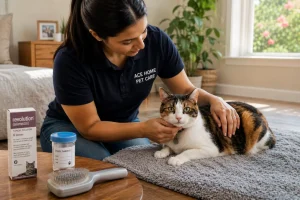
Many cats require ongoing medication: thyroid, kidney disease, diabetes, blood pressure. Tips for success:
- Pill pockets work for some cats, not others
- Hiding pills in food is often spotted by cats (they will eat around them)
- Compounded liquid medications from compounding pharmacies are often easier
- For multiple medications, a written daily log prevents missed doses
- Travel sitter coordination requires written protocols
For pet medication administration specifics, see our pet medication administration guide. For diabetic cats specifically, see our diabetic cat care during travel guide.
Frequently Asked Questions
How often do cats need vet visits?
Annual at minimum for adult cats, every 6 months for seniors (11+ years) or cats with chronic conditions. Most cat owners under-visit because cats hide illness; the proactive schedule catches problems early.
Do indoor cats need year-round parasite prevention?
Yes. Fleas come in on humans, dogs, and through open doors. Indoor-only cats still get fleas. Heartworm-carrying mosquitoes get into homes. Year-round prevention is the standard recommendation in Florida.
How do I introduce a new cat to my existing cat?
The right way takes 2-4 weeks of gradual introduction (scent swap, visual through gate, supervised contact). Done too fast, you create lasting tension. See our bringing home a second pet guide for the protocol.
Should I declaw my cat?
Most modern vets do not recommend declawing and many practices no longer perform it. The procedure is more invasive than commonly understood (it amputates the last bone of each toe). Alternatives include trimming claws, scratching posts, soft caps, and behavior training.
How long can I leave my cat alone during travel?
24 hours maximum without a check-in is the recommended limit for healthy adult cats. Beyond that, daily sitter visits are essential. Litter, water freshness, and emotional welfare all require attention. Boarding is rarely the right answer.
What is the most common Florida cat illness?
Kidney disease and diabetes are both highly common in Jacksonville cats, especially seniors. Both are manageable with early detection and proper care. Regular vet visits and bloodwork catch them early.
Cat Care That Actually Matches Florida
Generic cat care advice gets you most of the way there. The remaining 20% – Florida-specific risks, indoor vs outdoor calculus, local vet infrastructure, cat-aware sitter selection – is what separates good cat ownership from great cat ownership.
If you live in Mandarin, Southside, Fleming Island, Ponte Vedra, or Jacksonville Beach and want cat care that takes your cat as seriously as you do, our professional cat sitting and in-home pet care services are built around this approach. Cats are not small dogs, and our cat visits reflect that.