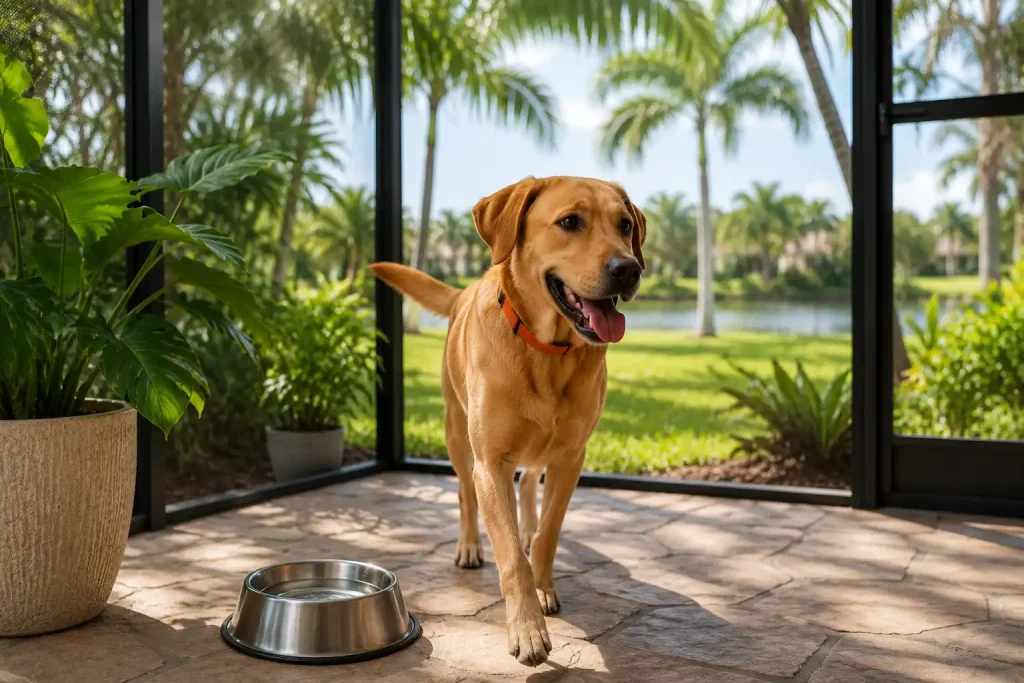
Moving to Florida changes pet ownership in ways the welcome packet does not warn you about. The heat you adjust to in a season. The parasites are year-round. The retention pond behind your house has alligators in it whether you have seen them or not. The lawn service spraying your neighbor’s yard creates exposure risk for your dog. The lovebug swarms in April will pile up on your lanai and your dog will eat them.
This is the working guide to Florida-specific pet health hazards, with what to watch for and how to plan around them. Bookmark it as your reference and check the linked articles for deep dives on each topic.
Why Florida Is Different
Three structural reasons Florida pet ownership requires more planning than most other states:
Year-round warm climate. Parasites do not die off. Pests do not migrate away. The same heat protection you need in July, you partially need in March.
Coexistence with wild predators. Alligators in retention ponds, golf course water hazards, and natural waterways. Florida has roughly 1.3 million alligators across all 67 counties. They live where you live.
Sun, humidity, and water exposure. Beach access creates saltwater risks. Florida humidity blunts the cooling effect of panting. Direct sun on pavement reaches dangerous temperatures by mid-morning much of the year.
The combination is not catastrophic if you plan for it. It is dangerous if you do not.
Heat and Humidity
Heat is the most common Florida-specific pet emergency and the most preventable. Most ER vet visits for heatstroke in Jacksonville happen between May and September.
Key facts:
- Normal dog body temperature is roughly 101.5 degrees Fahrenheit, plus or minus 1 degree
- Above 105 degrees is a true emergency
- Florida humidity reduces evaporative cooling from panting; dogs overheat faster than the air temperature alone would suggest
- Asphalt and concrete in summer can reach 130+ degrees Fahrenheit in afternoon sun
Practical schedule:
- May through September walks: before 9 AM or after 7 PM
- Use the back-of-hand pavement test before any outdoor activity
- Always carry water on outings longer than 15 minutes
- Never leave a pet in a car, even with windows cracked, even briefly
For heatstroke first aid, see our dog heatstroke first aid guide. For broader summer prevention, see our Jacksonville summer heat safety guide.
Year-Round Parasites
Florida’s mild winters mean fleas, ticks, and heartworm-carrying mosquitoes never go fully dormant. The result is that “skipping winter doses” of preventives almost always leads to infestation by spring.
The three main parasite categories:
- Fleas: present year-round, populations peak in warm wet months
- Ticks: present year-round, several species carry diseases including ehrlichiosis and Lyme disease
- Heartworm: transmitted by mosquitoes, Florida has among the highest heartworm rates in the country
Year-round preventives are non-negotiable in Jacksonville. The cost of prevention is dramatically lower than the cost of treatment for any of these.
See our year-round flea, tick, and heartworm guide for product comparisons and Florida-specific protocols.
Wildlife Threats
The Florida wildlife pet owners actually need to think about, ranked by frequency of incidents:
Alligators. Present in every freshwater body in Florida. Pets resemble natural prey. Smaller dogs are at highest risk. Reported attacks on dogs are far more common than attacks on humans, though precise numbers are not tracked. See our alligator awareness guide for Jacksonville dog owners.
Snakes. Florida has venomous species including cottonmouths, copperheads, rattlesnakes, and coral snakes. Most dog bites are from non-venomous snakes (the dog usually loses) but venomous strikes require immediate ER treatment.
Fire ants. Especially dangerous to small pets and animals that disturb a mound. Multiple stings can cause anaphylaxis in sensitive pets.
Bufo (cane) toads. Highly toxic when a dog mouths or bites one. Most active during warm wet evenings. If your dog has any contact with a Bufo toad, rinse their mouth out for several minutes with running water (pointing the head down so water does not go into the stomach) and head to the ER vet.
Coyotes. Present across Jacksonville and increasing. Most active dawn and dusk. Small pets are vulnerable, particularly when left unattended in yards.
For wildlife-related emergencies, the FWC Wildlife Alert hotline is 888-404-3922. For nuisance alligators specifically, the FWC Nuisance Alligator Hotline is 866-392-4286.
Seasonal Bugs
Beyond fleas and ticks, two seasonal Florida bug situations matter:
Lovebugs. Twice-yearly swarms in April-May and August-September. Dogs sometimes eat them in large quantities. While not acutely toxic, large ingestion can cause GI upset. The bigger risk is the chemical cleanup products people use on cars during lovebug season, which can be dangerous to pets. See our lovebug season dog safety guide.
Mosquitoes. Beyond heartworm transmission, mosquitoes can cause severe allergic reactions in some dogs and carry other diseases including West Nile virus in rare cases. Year-round preventives that include mosquito coverage are the main defense.
No-see-ums (biting midges). Beach areas have these in summer. Cause itchy bites but rarely a medical issue for pets.
Saltwater and Beach Risks
Beach access is one of the perks of Northeast Florida pet ownership, but it carries Florida-specific risks:
- Salt poisoning from drinking seawater
- Jellyfish stings (NE Florida waters have moon jellies, sea nettles, occasionally cannonball jellies)
- Rip currents that endanger swimming dogs
- Vibrio bacteria in warm coastal waters (dangerous for pets with open wounds)
- Hot sand causing paw pad burns
- Sand ingestion or impaction
See our saltwater and beach swimming risks guide for full coverage.
For current beach rules and seasonal restrictions, see our Ponte Vedra and Jacksonville Beach dog rules guide.
Brachycephalic Breeds in Florida
Flat-faced breeds (Frenchies, Bulldogs, Pugs, Boxers, Shih Tzus, Boston Terriers, Pekingese, Persian cats) struggle in Florida heat and humidity in ways that other breeds do not.
Why: Brachycephalic airways do not cool efficiently. The same panting that cools a Labrador overheats a Bulldog. Add Florida humidity (which reduces evaporative cooling further) and these breeds are at elevated risk of heatstroke even on moderate days.
Practical implications:
- Walk in cooler windows only
- Indoor activity during heat advisories
- Lower exercise thresholds before stress shows
- Higher index of suspicion for any panting or respiratory effort
- BOAS (Brachycephalic Obstructive Airway Syndrome) surgery is something many Florida brachycephalic owners discuss with their vet
For full coverage, see our brachycephalic dogs in Florida heat guide.
Lawn and Garden Chemicals
Florida year-round lawn maintenance means year-round chemical exposure risk for pets. The most common categories:
- Fertilizers (slow-release vs quick, with iron risk to dogs)
- Herbicides (2,4-D, glyphosate, others)
- Insecticides (especially organophosphates and pyrethrins on cats)
- Mosquito sprays (residential fogger services common in Florida)
- Pool chemicals
Three things every Florida pet owner should know:
- Standard wait time after lawn treatment is typically 24-48 hours before pets should access the area, but verify with the specific product label
- Neighbor lawn drift is real – your dog can be exposed to your neighbor’s chemicals through wind, runoff, or shared property lines
- Pet-safe lawn care companies exist; if you have pets, ask about pet-safe protocols when hiring
See our lawn chemical and pesticide safety guide for full coverage.
Hurricane Preparedness
Florida pet ownership includes hurricane preparation as a baseline responsibility. The full plan covers:
- Pet emergency kit (7 days of food, medications, water, copies of records)
- Evacuation destination plan (pet-friendly hotels book fast during named storms)
- Crate readiness if you do not normally crate
- Recent photos
- Updated microchip registration
See our hurricane pet safety guide for the full plan and timeline.
Emergency Vet Access by Area
Knowing where the nearest 24-hour emergency vet is before you need one is part of Florida pet ownership. The Jacksonville metro has several options depending on your neighborhood. See our emergency vets near Fleming Island guide for area coverage.
What This Looks Like in Practice
A Florida pet owner with adequate planning:
- Walks at dawn and after sunset in summer months
- Has year-round flea, tick, and heartworm preventives without gaps
- Knows the FWC alligator hotline number
- Has hurricane evacuation supplies ready by June 1
- Has identified pet-safe lawn care and removed sago palms from their yard
- Knows the nearest ER vet by address and phone number
- Has microchip registration current
- Has insurance coverage or an emergency vet savings account
None of this is exotic – it just becomes routine the way snow tires become routine in Minnesota. Florida pet ownership is not harder than anywhere else once you understand the local landscape.
Frequently Asked Questions
What is the single most important Florida pet care difference compared to other states?
Year-round parasite prevention. Skipping winter months of flea/tick/heartworm preventives in Florida almost always leads to infestation, and heartworm treatment is significantly more expensive and dangerous than prevention.
Are alligators really a daily concern for Jacksonville pet owners?
Daily, no. Always-on awareness, yes. Most owners never see one in their yard, but most neighborhoods have retention ponds or canals where alligators are present. The risk applies to walks past those waterways, not to every moment of pet ownership.
Is Florida heat really that different from other warm states?
The combination of heat and humidity is the differentiator. Texas and Arizona are hotter in absolute terms but have lower humidity, which means panting still cools dogs efficiently. Florida humidity reduces evaporative cooling, which means heat danger arrives at lower temperatures than dry-heat states.
What is the most underrated Florida pet hazard?
Two contenders. First, lawn and pesticide exposure – widespread and easy to underestimate. Second, retention ponds in residential neighborhoods – present everywhere, looks innocuous, can be deadly.
Do I need pet insurance more in Florida than other states?
Maybe. The combination of heartworm risk, heat-related emergencies, and tropical disease exposure means Florida pets statistically have more ER visits than pets in milder-climate states. The math typically favors insurance for higher-risk pets (brachycephalic breeds, active dogs near water, senior pets).
What should every Florida pet owner have saved in their phone?
Your regular vet. Nearest 24-hour ER vet. FWC Nuisance Alligator Hotline (866-392-4286). FWC Wildlife Alert (888-404-3922). ASPCA Poison Control (888-426-4435). Pet Poison Helpline (855-764-7661). Your microchip registry number.
Living in Florida, With a Pet
Florida pet ownership rewards owners who plan. The hazards are real but predictable, the climate is intense but manageable, and the wildlife is impressive but avoidable if you know where to look.
If you live in Mandarin, Southside, Fleming Island, Ponte Vedra, or Jacksonville Beach and want care that understands Florida-specific risks, our in-home pet care and professional pet sitting services are built around this knowledge.